A practical buyer’s guide to checking documentation, samples, production controls, traceability and support before a fleet-scale purchase.
A battery sample can pass a bench test and still fail the first production order. The gap often appears in details that were never pinned down: a different cell source, an untested discharge profile, a production site outside the audit scope, or a test summary that describes another battery configuration. A disciplined qualification process checks the product and the supplier’s ability to reproduce it.
For OEMs, integrators and fleet operators, the goal is not to collect the thickest document pack. It is to agree on measurable requirements, verify evidence against the exact battery design, and release production only when the sample-to-batch path is controlled.
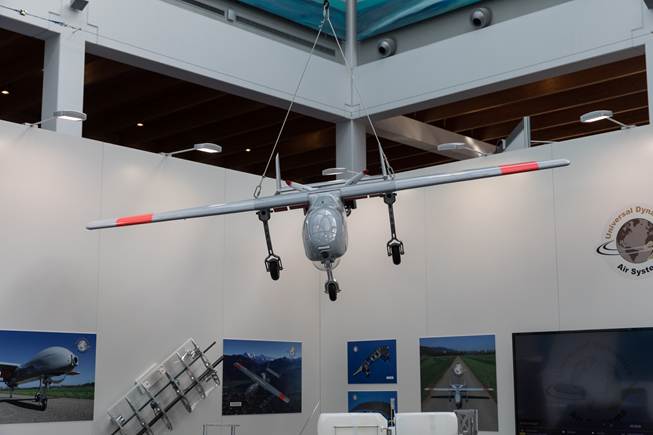
Platform type and mission profile both matter: qualify the battery against the exact aircraft configuration and duty cycle. Universal Dynamics UAV at AERO Friedrichshafen 2018. Photo: Matti Blume / Wikimedia Commons (CC BY-SA 4.0).
1. Start with the mission profile, not a catalog listing
Before comparing suppliers, issue the same technical brief to each one. A nominal voltage and capacity alone do not define a usable UAV battery. The pack must support the aircraft’s current demand, fit the available envelope, communicate with its controller and operate across the expected temperature and turnaround conditions.
Describe the aircraft and the work it performs: takeoff mass and payload range, motor and propulsion system, typical mission duration, current profile during takeoff and maneuvering, expected ambient temperatures, charge window, storage intervals, and the number of flights per operating day. State the interface requirements, including BMS data or CAN/UART protocol, mounting, connector, and charger behavior. If the flight profile varies, send representative logs or a defined load profile rather than asking the supplier to infer it.
| RFQ input | What it helps you verify |
| Voltage and usable energy | Electrical compatibility and the energy available under the agreed test conditions. |
| Continuous and peak load profile | Whether the pack can supply the real current demand without unacceptable voltage sag or thermal rise. |
| Aircraft, payload and environment | Whether sample tests and integration trials represent the intended mission. |
| Charge and communication interface | Whether charger limits, BMS behavior and aircraft telemetry are understood. |
| Mechanical envelope and service life target | Whether fit, mounting, handling and warranty expectations are clear before tooling or volume release. |
2. Verify the company and the actual production site
Confirm who will manufacture the battery, where final assembly and end-of-line testing will take place, and which operations are subcontracted. A trading company can be a capable supplier, but the buyer still needs a clear line of responsibility for engineering, quality records, warranty claims and corrective action.
Ask for the quality certificate and verify its issuer, validity, certified legal entity, site address and scope. If the supplier presents an ISO 9001 certificate, treat it as evidence about the management system, not proof that a particular UAV battery meets your performance or safety requirements. ISO’s supplier-selection guidance points buyers toward clear purchasing information, product approval and supplier monitoring; those controls still need to be applied to the battery program.
During a remote or on-site assessment, follow one sample through the process: incoming cell identification, assembly records, BMS programming, calibration, end-of-line testing, label application and serial or lot traceability. Ask how nonconforming units are segregated, how corrective actions are closed, and who approves deviations. The supplier should be able to explain the process and show records that match the model under review.
3. Match compliance documents to the exact battery design
For lithium batteries offered for transport under rules that incorporate the UN Manual of Tests and Criteria, subsection 38.3 is the relevant design-type test. In the United States, 49 CFR § 173.185 generally requires lithium cell and battery types to meet UN 38.3 and requires manufacturers and subsequent distributors of covered products to make a standardized test summary available. The rule provides specified exceptions to testing and record-keeping requirements for some low-production or prototype cases and certain motor-vehicle shipments to permitted storage or disposal sites, or for recycling. Confirm the requirements for the exact product, transport mode and route. UN 38.3 addresses transport design testing; it does not qualify an aircraft installation or prove mission performance.
For batteries covered by U.S. 49 CFR § 173.185(a)(3), the required test summary must include the manufacturer and contact details, test laboratory and contact details, report ID and date, cell or battery chemistry, mass, watt-hour rating or lithium content, physical description, cell/battery model or product model, tests and pass/fail results, assembled-battery test reference where applicable, UN Manual edition, and responsible person’s name and title. Confirm which requirements and exceptions apply to the product and route; other jurisdictions may differ. Compare the summary with the controlled product specification and BOM. Verify details such as cell model, series/parallel configuration, enclosure and BMS or firmware separately against the tested design. If a difference could affect the test result, ask the supplier for documented technical justification and confirmation of whether updated test evidence is needed. Do not treat a generic certificate image as proof that the offered production design is covered.
Then map other documents to the destination market and product category. Depending on the market and application, you may need additional product-safety, labeling, shipping, recycling or environmental documentation. Ask the importer or a qualified compliance specialist to confirm applicability rather than assuming one certificate covers every market.
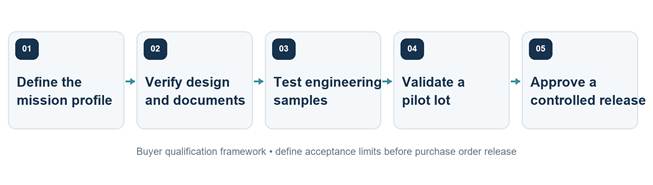
A buyer’s release workflow. It is a practical process map, not a measured industry benchmark.
4. Test engineering samples under representative load
Agree on a written sample test plan before the units arrive. Identify the sample revision, test equipment, ambient conditions, charge state, load profile, measurement points and pass/fail limits. Ask for the supplier’s own test report, then repeat the checks that matter to your aircraft using your own lab or a qualified test partner.
A useful engineering review typically compares stated capacity or energy under defined conditions, voltage response under representative current, temperature rise at relevant locations, BMS protections and telemetry, charging behavior, physical fit, and aircraft warnings or cutbacks. Test more than one unit so you can see whether results are repeatable; select the sample count and acceptance method based on risk, production volume and the consequence of failure. There is no universal sample count that is right for every UAV battery program.
Do not improvise destructive or abuse tests on a workbench. Safety and transport tests should be planned and performed by competent laboratories under the applicable procedure. A successful flight is useful integration evidence, but it does not establish long-term life, batch consistency or regulatory compliance on its own.
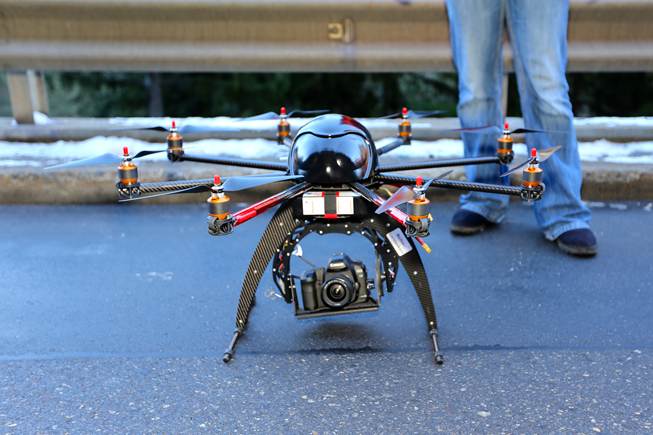
A professional octocopter configured for rock-slope scanning and photogrammetry. Field validation should use the production-intent battery, aircraft configuration and operating procedure. Photo: Jürg Vollmer / Wikimedia Commons (CC BY-SA 3.0).
5. Bridge the gap from sample to pilot lot
The engineering sample proves that a design can work. A pilot lot shows whether the intended production process can reproduce it. Place the pilot build against a controlled specification and require the supplier to identify the cell lot, BOM revision, firmware version, production line and inspection records for each shipped unit or lot.
Before testing begins, write acceptance limits for the characteristics that could stop a mission: identity and configuration, capacity or energy, electrical performance under the agreed profile, BMS communication, fit and finish, and required documentation. Decide how units will be sampled, how a failure will be contained, and who authorizes rework or retest. Keep the first pilot results as the baseline for future lot comparisons.
A supplier who offers only hand-selected samples, but cannot connect them to a controlled production build, has not yet demonstrated production readiness. Ask to see the actual production test flow and a sample of the records it creates.
6. Put change control and after-sales support in writing
Cell models and sources, BMS hardware or firmware, protection settings, assembly location, process steps and critical materials can all affect pack behavior. The purchase agreement or quality agreement should require written notice before a change that could affect fit, performance, safety, compliance or interchangeability. Define which changes trigger document review, partial retesting or full requalification.
Also agree on what happens after shipment: serial-number traceability, warranty start and coverage, failure-analysis turnaround, replacement or repair process, spare-parts availability, escalation contacts and end-of-life notice. For a fleet buyer, a battery that can be diagnosed and replaced quickly may be more valuable than a small difference in quoted price.
7. Make the first production release a documented decision
Use a short approval record signed by engineering, quality and procurement. It should identify the approved specification and revision, evidence reviewed, test results, open actions, permitted deviations, initial order scope and conditions that suspend approval. Keep unresolved critical gaps visible; do not let an attractive sample or a tight delivery date silently become a production waiver.
Pause the order if the supplier cannot link documents to the offered design, refuses to identify the production site or critical sub-suppliers, cannot provide lot-level traceability, changes the design without notice, or leaves a safety-critical test failure unexplained. Conditional approval can work for a low-risk open item when the owner, deadline and containment are written down. A critical safety or compliance gap should remain a stop condition.
First-order supplier qualification checklist
- The RFQ describes the aircraft, duty cycle, current profile, environment, charging and interfaces.
- The legal manufacturer, production site, subcontracted steps and accountable contacts are identified.
- Quality-system evidence is current and covers the site and processes relevant to the order.
- The applicable UN 38.3 test summary identifies the offered model, and configuration details are checked against controlled design records.
- Engineering samples passed an agreed bench and aircraft integration test plan.
- A production-intent pilot lot passed pre-agreed acceptance checks with traceable records.
- Change notification, requalification triggers, warranty and failure response are documented.
- Engineering, quality and procurement approved the same specification revision for release.
The strongest supplier qualification process gives every shortlisted manufacturer the same mission brief and the same release criteria. That makes proposals easier to compare and creates a practical baseline for the relationship after the first production order.
Technical references and image credits
PHMSA, Lithium Battery Test Summaries (2024 guide): official guidance
U.S. eCFR, 49 CFR § 173.185, Lithium cells and batteries: current rule text
ISO, ISO 9001 in the supply chain: supplier selection guide
Image 1: Universal Dynamics UAV at AERO Friedrichshafen 2018. Photo: Matti Blume / Wikimedia Commons; source page • CC BY-SA 4.0
Image 2: Octocopter for rock-slope scanning. Photo: Jürg Vollmer / Wikimedia Commons; source page • CC BY-SA 3.0