A drone fleet can fly only a few dozen missions and still discover that some of its batteries no longer deliver the expected runtime or peak power. That looks contradictory only if cycle count is treated as the battery’s entire history. It is not.
Lithium ion batteries age in two ways. Cycling adds wear when energy moves in and out. Calendar aging continues while the pack is resting. Time, storage state of charge, temperature and the pack’s own electronics can keep changing the battery even when the aircraft stays in its case.
For industrial UAV operators, the practical lesson is simple. A low cycle count does not prove that a pack is young, healthy or mission ready. A useful battery policy must track how long the pack has existed, how long it has waited at high charge, where it was stored and what it can deliver under load.
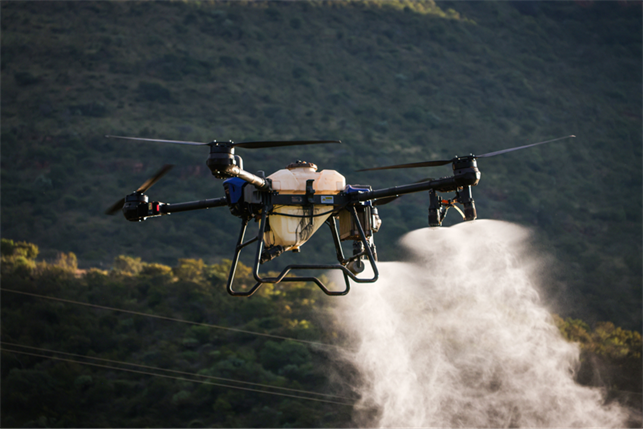
Figure 1. Industrial UAV batteries spend only part of their life in the air. The hours before and after a mission can matter just as much as the flight itself. Photo by Magda Ehlers on Pexels
Cycle count is an odometer while calendar age is a clock
Cycle count measures use, but even that number needs context. One shallow discharge is not the same stress as a full high power mission, and different BMS platforms may count cycles differently. Calendar aging measures the damage that accumulates with elapsed time under particular storage conditions. Both processes can reduce capacity and increase internal resistance.
| What the fleet sees | Likely aging category | What the record must include |
| Frequent deep missions and high current | Cycle aging plus calendar aging | Energy throughput, depth of discharge, current, temperature and elapsed time |
| Few flights but long periods near full charge | Calendar aging can dominate | Time at high SOC, storage temperature and battery age |
| Long storage at very low charge | Self discharge and BMS draw can create over discharge risk | Initial SOC, inspection interval, pack voltage and BMS state |
| Occasional missions after storage | Stored damage may appear only under load | Voltage sag, cell delta, temperature rise and delivered energy |
This is why an emergency response battery that has completed 30 cycles can be in worse condition than a survey battery with 150 well managed cycles. The comparison is possible, but only when the operator knows the exposure behind each number.
Chemical reactions do not stop when the drone lands
A resting lithium ion cell is not chemically frozen. Side reactions continue at the electrode and electrolyte interfaces. One important process is growth of the solid electrolyte interphase on the graphite anode. That layer is necessary for normal operation, but continued growth consumes cyclable lithium. Other reactions can degrade electrolyte, create gas, reduce active material or increase resistance. Research models commonly treat these calendar effects separately from cycling effects. [1][2][3]
Capacity loss is only one outcome. Rising resistance can reduce the voltage that remains available during takeoff, climbing or payload operation. A battery may still charge to the expected voltage and show a reassuring SOC at rest, then sag earlier under a high current demand. For an aircraft, that loss of power capability may become operationally important before a capacity test reaches an arbitrary retirement threshold.
Chemistry and cell design matter. NMC, NCA, LFP and blended cathodes do not produce identical aging curves. Pouch, cylindrical and prismatic formats also differ. A large review published in Joule analyzed 232 commercial cells across eight cell types and five manufacturers, with calendar data extending as long as 13 years. The authors emphasized that simple temperature and time models do not describe every degradation trend reliably. [2] Buyers should therefore reject universal claims such as a fixed percentage loss per month for every drone battery.
The data show why heat and high charge deserve attention
A controlled 2017 study stored a commercial graphite and NMC LMO pouch cell at different temperatures and states of charge. After nine months at 100% SOC, the researchers reported approximately 10% capacity loss at 35 °C and approximately 43% at 60 °C. [1] The 60 °C condition is an accelerated extreme test, not a normal warehouse recommendation, but the comparison clearly shows how strongly heat can amplify idle time in that specific cell system.
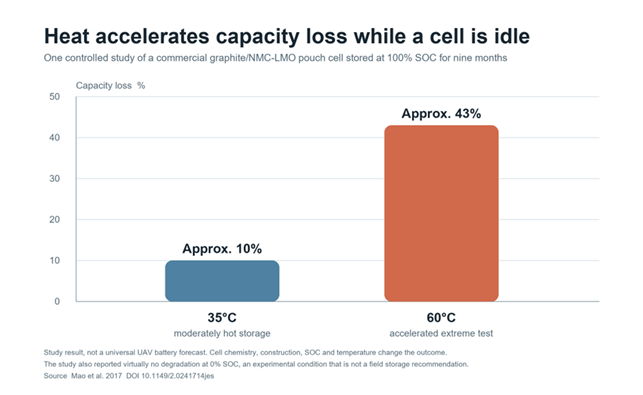
Figure 2. Reported capacity loss after nine months at 100% SOC in one commercial graphite/NMC-LMO pouch-cell study. These values describe the tested cell and conditions; they are not a forecast for every industrial UAV pack. Data source Mao et al. 2017
The same paper reported virtually no degradation for cells stored at 0% SOC under its test definition. That is useful scientific evidence about SOC dependence, but it is not advice to leave a drone battery empty. A real pack has self discharge and may also have BMS standby consumption. Storing it near empty can allow one cell group or the complete pack to fall into damaging over discharge. Storage targets must come from the supplier for the exact pack.
A more recent open dataset published in 2026 examined NMC graphite cells during calendar and cycle aging and included storage at 80% and 100% SOC at 0 °C, 25 °C and 40 °C, with both capacity tests and impedance measurements. [4] Its design reflects a point that matters to UAV fleets: health assessment should look at power related behavior as well as remaining ampere hours.
Standby operation can be a demanding duty cycle
The highest calendar stress often comes from a reasonable operational goal: keep every battery full so the aircraft can leave immediately. Public safety, security and inspection teams may charge packs after every mission, place them in a vehicle or cabinet and then wait. If the next call arrives quickly, the strategy works. If it does not, the battery spends more time at a high electrode potential, sometimes in a warm environment.
A hot vehicle is especially problematic. The pack can finish a mission warm, absorb more heat from the cabin and remain fully charged for hours or days. Charging a hot pack immediately after landing adds another avoidable exposure. DJI’s general battery maintenance guide instructs users to let the battery cool fully before charging and, for the covered products, recommends 40% to 65% for storage beyond ten days in an ideally cool and dry 22 °C to 28 °C environment. [6] Those figures apply to DJI’s listed products. A custom industrial pack may have a different approved window.
Manufacturer service life rules show that elapsed exposure is not theoretical. DJI states that the TB65 battery reaches its service-life limit by whichever comes first: 12 months, 400 cycles or 120 days of high-power storage. [5] This is a product-specific rule, not an industry standard, but it makes the commercial point unusually clear. A battery can consume life while waiting at high charge even if its cycle counter barely moves.
Low cycle count can hide three different losses
Less usable energy
Loss of cyclable lithium and active material reduces the energy that can be removed between the pack’s upper and lower voltage limits. Flight time may shrink gradually, so crews can adapt without realizing that the original reserve margin has disappeared.
Less power under load
Resistance growth creates more voltage drop and heat at a given current. The pack may look normal on the bench but trigger an earlier low-voltage warning during takeoff, a climb or a heavy payload segment. A capacity-only check can miss this change.
Less consistency between cell groups
Calendar exposure and manufacturing variation do not affect every cell group identically. One weak group can reach a protection threshold before the rest of the pack. The useful output of the entire series pack is then limited by that weakest group, especially at low SOC or high current.
Readiness and battery life need an operating policy
The answer is not to keep an emergency fleet permanently half charged or to promise that every pack will last longer at one universal SOC. The answer is to define readiness tiers and control time at high charge. Scheduled missions can be charged close to dispatch. Immediate response packs can remain in a supplier-approved ready state while other packs rotate through a lower storage state.
Commercial systems already use this logic. DJI describes a Storage mode that targets 50% and a Ready-to-Fly mode that charges to 90% for its BS65 and TB65 ecosystem. [7] The percentages belong to that product family, but the architecture is broadly useful: separate the level needed for long-term storage from the level needed for short-notice deployment.
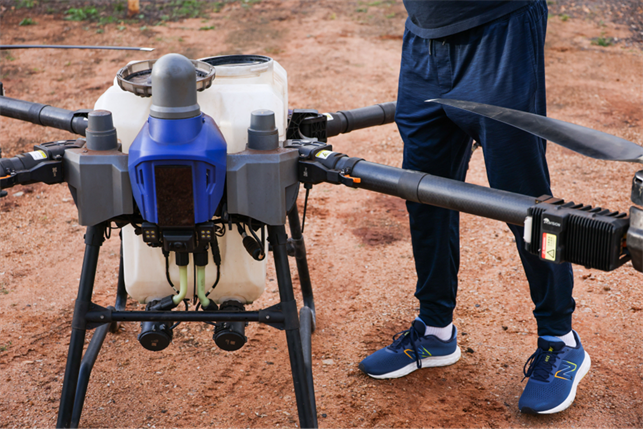
Figure 3. Mission readiness is a fleet-level decision. Charging time, dispatch notice, pack rotation and storage conditions should be planned together. Photo by Magda Ehlers on Pexels
A practical four tier storage policy
The time bands below are planning categories rather than universal battery limits. Each operator should replace them with values approved for its pack, BMS and mission profile.
| Readiness tier | Operating approach | Control to document |
| Immediate dispatch | Maintain only the packs required for the response commitment at the approved ready SOC | Maximum time at ready SOC, storage temperature and rotation order |
| Next scheduled shift | Delay final charging until the expected mission and allow packs to cool before recharge | Charge completion time, mission time and pack temperature |
| Warm reserve | Use the supplier’s partial storage SOC and rotate packs through an approved functional check | Inspection interval, voltage, cell delta, BMS status and physical condition |
| Long-term reserve | Follow the exact storage SOC, temperature and maintenance schedule for the model | Storage start date, periodic check, recharge record and return-to-service test |
The policy should also state what happens during a power outage, a missed inspection or a BMS firmware change. If the pack depends on automatic self discharge, confirm the delay, target, quiescent current and behavior when the pack enters hibernation. An auto-discharge function reduces one risk only when it is enabled, understood and periodically verified.
What an industrial buyer should ask the battery supplier
A cycle-life claim alone is incomplete for a fleet that spends most of its time on standby. The RFQ and technical agreement should cover calendar conditions explicitly. Ask for:
- The exact cell chemistry and pack configuration used in the quoted product.
- The approved storage SOC range for short, medium and long storage periods.
- Storage-temperature limits and the conditions used for calendar-life validation.
- BMS standby current, hibernation logic, automatic discharge behavior and wake procedure.
- Any limit on cumulative days at high SOC or in a ready-to-fly state.
- Service-life criteria in months, cycles and measurable health indicators, including which limit takes precedence.
- End-of-life criteria for capacity, DC resistance, cell-group voltage spread, temperature behavior and fault history.
- The inspection and recharge interval during storage, plus the approved return-to-service test.
- Warranty exclusions related to temperature, SOC, missed maintenance, water ingress or over discharge.
For custom UAV projects, the supplier should validate the complete pack rather than transfer a cell-level calendar-life number directly to the finished battery. Compression, thermal design, BMS consumption, cell matching and the aircraft’s current profile all influence the result.
Use the battery log to measure exposure
A useful fleet log records more than cycle count. At minimum, retain manufacture or commissioning date, cumulative days above the supplier’s high-SOC threshold, maximum and average storage temperature, delivered energy, voltage sag during a repeatable load, cell-group delta, peak temperature and fault events. The exact fields depend on what the BMS can export.
Trend the data by battery serial number. Comparing packs only at full charge can hide resistance growth; comparing them during a repeatable mission segment or controlled load gives a clearer view of usable power. When a pack behaves differently, quarantine it and use the supplier’s evaluation process rather than repeatedly flying it to reproduce the fault.
Common questions about batteries that rarely fly
Is an unused two year old drone battery as good as a new one
Not necessarily. Its condition depends on chemistry, storage SOC, temperature, BMS draw and maintenance. Low cycles describe usage, not the absence of calendar aging.
Should emergency batteries stay at 100 percent
Only when the manufacturer approves that readiness strategy and the operation accepts the life tradeoff. Keep the smallest practical ready pool, control temperature, rotate serial numbers and track cumulative time at high SOC.
Does automatic discharge solve the problem
It can reduce time at high SOC, but it does not remove heat exposure, BMS consumption, low-SOC over-discharge risk or the need for inspections. Confirm the feature’s timing and target for the exact model.
Can cycle count predict retirement
Cycle count can be one retirement trigger, but it should sit beside calendar age, high-SOC exposure and measured performance. The earliest applicable limit should govern.
Is zero percent the best storage level
No generic recommendation should be taken from a laboratory comparison. A real pack stored near empty can continue to discharge and become permanently damaged. Follow the model-specific storage target and maintenance interval.
Manage standby time as part of the mission
The battery does not stop aging when the propellers stop. A pack that spends months fully charged in a warm cabinet may accumulate more calendar stress than its cycle counter suggests. The fleet therefore needs two records: how much the battery has worked and how it has waited.
For an OEM or fleet battery review, provide the chemistry, voltage, capacity, peak and continuous current, ambient range, dispatch notice, desired ready SOC, storage duration and BMS data requirements. That information allows the supplier to design a storage and readiness strategy around the real mission instead of quoting cycle life in isolation.
Sources
Technical and manufacturer sources checked on 22 September 2026. Research values remain specific to the tested cells and conditions. Manufacturer instructions remain specific to the stated product family and current document revision.
[5] DJI Matrice 350 RTK FAQ, TB65 storage behavior and service life criteria
[7] DJI Matrice 350 RTK product page, Battery Station Storage and Ready to Fly modes