A bigger drone battery can extend flight time, but the gain depends on how much usable energy it adds relative to the extra power the aircraft needs. A heavier pack increases takeoff weight. Its rated capacity may also be measured under conditions that differ from the actual flight. A percentage increase in capacity cannot, by itself, predict the additional minutes in the air.
For UAV manufacturers and fleet operators, the useful comparison is flight time with the required payload, a defined mission and an appropriate landing reserve. This guide focuses on battery-powered multirotors used for inspection, mapping and agricultural work. Fixed-wing aircraft and hybrid VTOL platforms need their own mission power models.
Compare watt hours before comparing capacity
Milliamp-hours describe electric charge. Watt-hours describe energy. If two packs have different nominal voltages, comparing their mAh ratings alone can give a misleading impression of the energy available. Use the manufacturer’s published watt-hour value, or calculate a nominal estimate from voltage and capacity:
Nominal energy (Wh) = nominal voltage (V) × capacity (Ah)
Divide mAh by 1,000 to obtain Ah. For a system with several batteries, add the energy ratings of all installed packs. Keep nominal voltage separate from the fully charged voltage; they serve different purposes when comparing energy and checking electrical compatibility.
A useful first estimate of endurance is:
Flight time (minutes) ≈ 60 × usable battery energy (Wh) ÷ average electrical power (W)
Here, usable energy means the energy delivered before the agreed landing reserve or operating limit is reached. Average power must cover the same mission, including propulsion and equipment supplied by the flight battery. It should be recalculated or measured for the proposed battery configuration. Reusing the lighter aircraft’s power consumption is a common source of optimistic estimates.
A published comparison from an industrial drone
The legacy DJI Matrice 600 provides a useful documented comparison. DJI lists two six-battery configurations, with total nominal energy of 599.40 Wh and 779.76 Wh, calculated from the individual pack ratings. Published no-payload hover time rises from 35 to 40 minutes. [1]
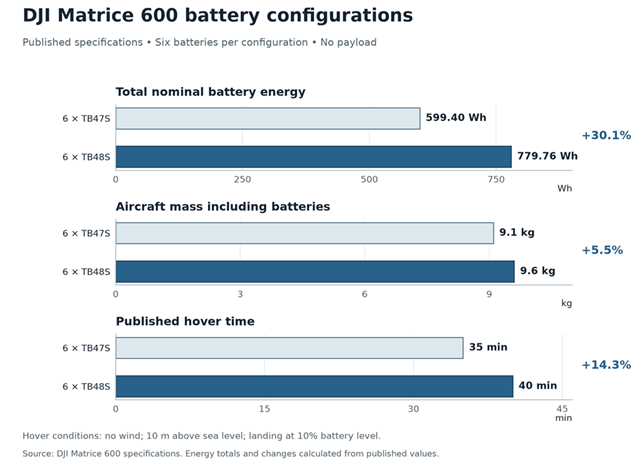
That is 30.1% more nominal energy and 14.3% more hover time. The extra five minutes can be valuable, but the improvement is not proportional. These specifications do not isolate the contribution of weight, battery behavior or control settings. They also cannot predict the gain on another UAV. The loaded figures are excluded because DJI specifies different payloads for those configurations.
Extra battery mass increases propulsion demand
During hover, a multirotor must generate enough thrust to support the whole aircraft. Adding battery mass therefore increases the propulsion power requirement throughout the flight. Unlike fuel, a battery remains essentially the same mass as its stored energy is used.
A simplified multirotor hover model relates propulsion power to total mass raised to the power of 1.5, with the propeller system and operating assumptions held constant. That relationship explains why the power penalty can grow faster than aircraft mass. The model has limits: actual electrical consumption also depends on motor and propeller efficiency, air density and equipment loads. [2]
This creates diminishing returns when capacity is added by making the battery heavier. A pack with higher usable energy at the same installed mass avoids that particular penalty. A larger pack can still be the right choice if its extra energy outweighs the additional demand and the aircraft retains the required thrust and payload margins.
Weigh the complete installation. A mounting tray, protective enclosure, longer cables or a different connector may change the result enough to matter in a tightly constrained design.
Rated capacity is only part of usable energy
A discharge test ends at a specified voltage, temperature and current. A drone follows a changing load profile, with different demands during takeoff, climb, cruise and landing. Ask the supplier for the test conditions behind the capacity figure and for a discharge curve that represents your application.
Under load, internal resistance contributes to a voltage drop. Cold conditions, state of charge and aging affect that resistance and the energy that can be delivered before a voltage limit is reached. Texas Instruments describes these dependencies in its battery fuel-gauging guidance. A pack that looks healthy at rest may behave differently during a high-current climb. [3]
Current capability matters alongside energy. A C-rating expresses a declared discharge rate relative to capacity, but it does not show the voltage and temperature behavior over your mission. Request continuous and peak current limits, peak duration, cooling conditions and pack-level measurements. Include the wiring and connectors in the assessment.

The flight can end before the battery is empty
Battery protection and flight-controller thresholds help determine when a mission ends. ArduPilot Copter, for example, can trigger a battery failsafe from low voltage or estimated remaining capacity, and can use raw or sag-corrected voltage. The trigger and response depend on configuration. [4]
When a larger pack produces little additional time, check the flight log for the event that ended the mission. Was it a voltage threshold, a remaining-capacity estimate, a thermal limit or the planned return reserve? Those findings lead to different corrective actions.
For configurable systems, confirm that battery capacity, cell count and monitoring calibration match the approved installation. Validate any configuration change with the aircraft integrator. Extending a test by reducing its landing reserve changes the comparison and can consume the margin needed for a reliable return.
Test the battery against the actual mission
A no-payload hover figure cannot describe a survey route or a full spray mission. Researchers from Carnegie Mellon recorded 209 Matrice 100 flights while varying payload, ground speed and cruise altitude, and measuring wind and electrical power. Those variables also matter when comparing batteries. [5]
The meaning of an improvement also depends on the job. For an inspection team, useful time at the asset may matter more than total airborne time. For spraying, the relevant comparison may be area treated with the same application rate and starting load. Record the work completed as well as the landing time.
A practical comparison should follow the same route, payload, flight settings and reserve policy. Record starting battery temperature and state of charge, and keep conditions as similar as practical. Use healthy packs of comparable age, alternate the test order and repeat the comparison. Report the observed spread as well as the average; a single favorable flight is weak evidence for a fleet purchase.
What to request before buying a larger UAV battery
A useful quotation should connect the battery specification to the aircraft and its operating requirements. The following information makes competing proposals easier to assess.
| Information to request | What it helps establish |
| Pack energy and complete installed mass | Whether usable energy per kilogram improves after mounting hardware is included. |
| Discharge curves at the intended temperature and load | Whether the pack can sustain the mission before reaching voltage or temperature limits. |
| Voltage range and continuous and peak current limits | Compatibility with the propulsion system, electronics, wiring and connectors. |
| Battery management and communication details | Whether telemetry, monitoring and protection behavior can be integrated correctly. |
| A comparable flight test with the required payload | How much useful operating time the proposed battery actually adds. |
| Charging requirements and service-life test conditions | How the battery fits the fleet’s turnaround schedule and replacement planning. |
For procurement, compare the cost per completed mission alongside the purchase price. Extra endurance has commercial value when it adds productive work, reduces a battery change or supports the required reserve. Charging time, cooling time and replacement intervals affect whether that benefit carries through a working day.
Common battery sizing questions
Can a larger battery reduce flight time
Yes, if average power demand rises by a greater percentage than usable energy. Added mass and installation losses can contribute to that outcome. Confirm the result with a matched test on the specific aircraft.
Is a higher C rating better for endurance
A higher C-rating alone does not establish longer endurance. Evaluate usable energy, installed mass, voltage under load and temperature through the mission. Current capability must be sufficient for the aircraft’s demands.
Which battery specification should a buyer prioritize
Start with electrical and mechanical compatibility, then compare usable watt-hours at the intended load and temperature against installed mass. Use flight results with the required payload to make the final selection.
Planning a battery change for an industrial UAV? Send your current pack specification, aircraft mass, payload, mission duration and available flight logs with your inquiry. A quotation based on those inputs can address the extra working time your aircraft needs.
Sources
[1] DJI — Matrice 600 specifications
[2] Jain et al. — Staging energy sources to extend flight time of a multirotor UAV (2020)
[3] Keller and Banak — Getting the most battery life from portable systems, Texas Instruments (2008)