Search and rescue drones are no longer just impressive emergency gadgets. They are becoming practical tools for first responders, disaster teams, park rescue units, fire departments, police aviation teams and volunteer SAR groups. When a person is missing in mountains, after a flood, near a canyon, or inside a disaster zone, an unmanned aircraft can put eyes in the air before a crew can safely enter the area.
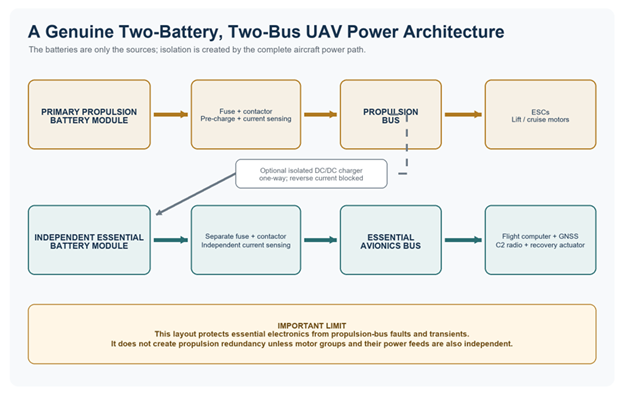
For drone battery buyers, the important point is this: search and rescue is rarely a standard mission. It is a non-standard operating environment with non-standard payloads, non-standard flight profiles, and non-standard safety expectations. That is why many serious SAR UAV programs should not rely only on off-the-shelf consumer drone batteries. They need custom lithium battery packs designed around mission reality.
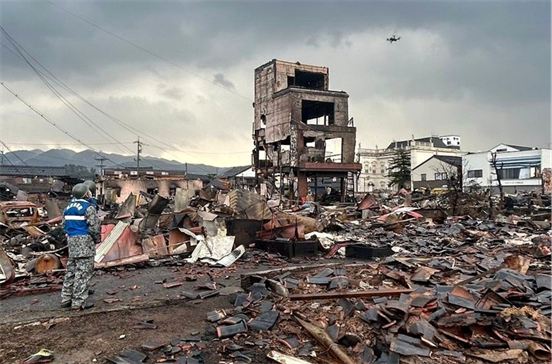
Disaster-zone drone search highlights why emergency UAVs need dependable custom power systems. Photo: Japan Air Self-Defense Force, CC BY 4.0, via Wikimedia Commons.
Why Search and Rescue UAVs Are a Hotter Topic Now
Recent public-safety signals point in the same direction. The FAA’s emergency UAS page, last updated in June 2026, lists search and rescue, firefighting, law enforcement, damage assessment, disaster recovery support and critical infrastructure restoration as operations that may be considered for expedited approval through its Special Governmental Interest process. In the same guidance, the FAA notes that beyond visual line of sight approvals for emergency operations may require extra processing and temporary flight restrictions.
The FAA’s wildfire UAS page also describes unmanned aircraft as tools for real-time situational awareness, hotspot detection and safer operations in high-risk environments. NIST’s public safety communications research program says first responders frequently rely on UAS to gather data and provide situational awareness in dangerous environments with degraded communications. NIST has also supported UAS challenges for first responders, including search and rescue operations. These are not advertising claims; they are official signals that public-safety drones are becoming part of the emergency response toolkit.
Standard Battery Packs Are Often the Wrong Starting Point
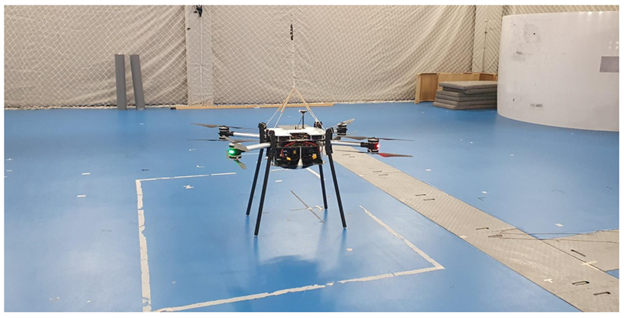
A consumer drone battery is usually designed for a known aircraft, a controlled payload and predictable hobby or inspection use. A search and rescue drone may be very different. It may carry thermal cameras, visible-light zoom cameras, loudspeakers, spotlights, mapping modules, communication relays, rescue-drop devices or weather sensors. It may fly in cold mountains, hot wildfire zones, rainy roadsides, coastal wind or dusty collapsed-building environments. The battery is not simply a removable accessory; it is part of the aircraft’s survival system.
This is where the non-standard battery category becomes valuable. A custom SAR drone battery can be designed around the aircraft body, center of gravity, connector position, battery bay dimensions, voltage platform, current demand, discharge curve, BMS communication protocol and field charging method. In a real emergency, small design choices matter. A weak connector, an inaccurate state-of-charge reading, a pack that cools too quickly, or a battery that cannot be swapped with gloves can reduce the usefulness of the entire UAV system.

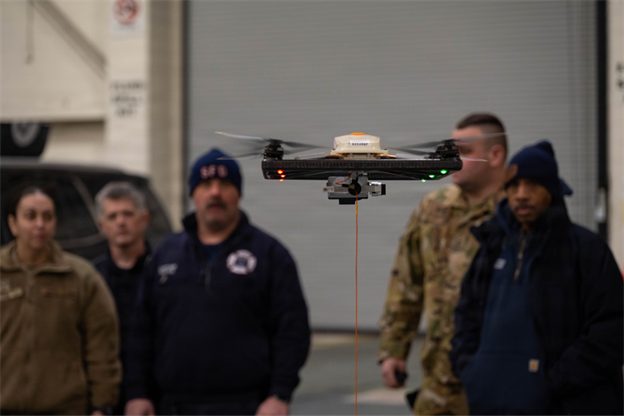
A SAR drone operator in complex terrain. Custom packs must support long standby, stable discharge and mission-ready swaps. Photo: Grand Canyon National Park, CC BY 2.0, via Wikimedia Commons.
What a Custom SAR Drone Battery Should Solve
The first requirement is not the biggest capacity number on a label. It is usable mission energy. SAR teams need enough power for takeoff, climb, wind correction, loitering, payload operation and safe return. A thermal camera and spotlight may draw continuous power while the aircraft is hovering. A mountain operation may require extra reserve because wind, altitude and cold temperatures reduce performance. A custom pack should be evaluated by the mission profile, not only by nominal amp-hours.
The second requirement is reliable high-current performance. Search and rescue drones often need strong bursts of power for vertical climb, sudden repositioning or flight with heavier payloads. If voltage drops too quickly under load, the aircraft may shorten its flight, trigger early warnings or lose useful payload time. Cell selection, parallel structure, discharge rating, internal resistance and pack-level thermal design all become procurement questions.
The third requirement is intelligent protection. A good BMS should do more than prevent basic overcharge and over-discharge. For professional UAV use, buyers should ask for cell balancing, pack temperature monitoring, cycle count, state-of-health estimation, alarm history and communication with the aircraft or charger. Fleet operators want to know which packs are ready, which packs are aging, and which packs should be removed before a mission.
| Non-standard factor | Why it matters in SAR | Buyer specification |
| Battery geometry | SAR aircraft may have custom frames, payload bays or sealed compartments. | Define pack size, mounting, center of gravity and locking method. |
| Thermal range | Cold mountains, hot roofs and wildfire support can change performance fast. | Request test data under realistic low/high-temperature discharge. |
| BMS data | Fleet teams need pack status before launch, not after a failure. | Ask for SOC, SOH, temperature, alarms, cycle count and communication protocol. |
| Fast swap design | Rescue teams may rotate packs from vehicles or field charging cases. | Specify handles, glove-friendly latches, connector life and charger matching. |
| Transport documents | Exported lithium batteries must move through air/sea/courier channels safely. | Prepare UN38.3, MSDS, labels, packaging and test summaries. |
Where Custom Batteries Create Real Value
Mountain rescue is one of the clearest examples. A UAV may launch from a ridge, search over steep terrain and return in wind and cold. The battery pack must maintain voltage, keep accurate remaining-capacity data and remain easy to replace with limited workspace. Disaster response is another strong use case. After earthquakes, fires or storms, drones may fly over debris, damaged roads and unsafe structures where rescue teams need aerial awareness before committing people.
Wildfire support adds a different requirement: heat, smoke, long standby and repeated sorties. Flood and coastal rescue may require corrosion-resistant connectors and better sealing. Night search may require continuous payload power for thermal imaging and lighting. The battery supplier who understands these differences can become more than a component vendor. They can become part of the rescue system design.
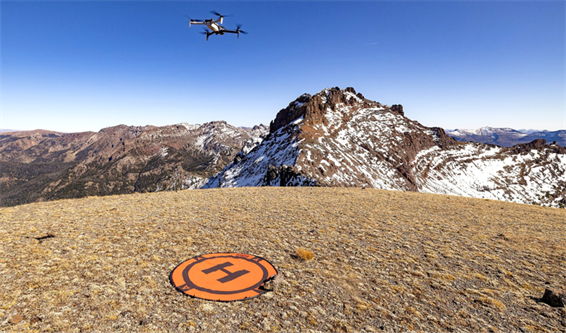
Mountain SAR flights show why battery design must account for altitude, wind, cold and reserve power. Photo: NPS / Jacob W. Frank, public domain, via Wikimedia Commons.
A Practical Sourcing Framework for Global Buyers
Before buying a SAR drone battery, a global buyer should define the mission rather than only request a voltage and capacity. What aircraft will use the pack? What is the payload weight? How long must it hover with thermal imaging active? What is the lowest and highest operating temperature? Will the battery be swapped by gloved operators? Will packs be charged in a rescue vehicle, a portable power station or a base station? How many cycles are expected in training versus real deployment?
A serious custom battery supplier should respond with engineering details: cell chemistry, pack structure, discharge curve, BMS functions, connector type, enclosure material, sealing approach, charger compatibility, thermal test conditions and documentation for transport. For export customers, UN38.3 and MSDS are not optional paperwork. They are part of trust. For public-safety users, traceability, batch consistency and after-sales support are also part of the product.
Questions Buyers Should Ask Before a Non-Standard Order
A non-standard SAR battery order should begin with a technical conversation, not only a quotation. Buyers should ask whether the supplier can design around exact pack dimensions, connector orientation, cable length, shell material, waterproofing level, anti-vibration requirements and the drone’s center-of-gravity limits. They should also ask how the battery behaves after storage, how fast it can safely recharge, and whether the charger can be used from a rescue vehicle or portable field power supply.
For fleet operators, consistency is just as important as peak performance. A rescue team may own dozens of packs and rotate them across training and real missions. If one pack ages faster than the others, the aircraft may behave unpredictably. If serial numbers, production batches and test records are not traceable, maintenance becomes guesswork. For this reason, serious buyers should request batch-level quality control, sample testing before mass production, and clear replacement rules for aging or damaged packs.
Future Direction: Smarter, Modular, Mission-Specific Power
The next stage of SAR drone batteries will be smarter and more modular. Rescue teams will want battery packs that report health before deployment, connect cleanly to fleet-management software, support fast field rotation, and maintain stable performance across different payloads. Battery suppliers will need to offer configurable platforms rather than only one fixed SKU: different voltage platforms, different capacity shells, ruggedized options, heater-assisted low-temperature packs, and BMS firmware tailored to the drone.
The opportunity is especially strong for exporters that can combine manufacturing flexibility with documentation discipline. The buyer does not simply want a battery that can fly once. They want a pack that can be trusted after storage, after repeated training cycles, after transport, after cold mornings, and during the mission that matters most.
Conclusion: In Rescue Work, Custom Power Is Not a Luxury
Search and rescue drones are becoming more important because they help teams see faster, search wider and reduce risk to responders. But the more serious the mission becomes, the less suitable a generic battery may be. A non-standard SAR UAV battery must match the aircraft, payload, climate, charging process, safety documentation and field workflow.
For OEMs, importers, rescue-equipment distributors and professional UAV integrators, the message is simple: do not source the battery last. Treat it as a mission-critical subsystem. In search and rescue, reliable custom lithium power can be the difference between a drone that looks capable and a drone that is truly ready when the call comes.