The Battery Behind China’s Next Industrial Era
Lithium-ion batteries are often described as a component of the electric-vehicle revolution. In China, they have become something larger: a strategic industrial platform connecting automobiles, consumer electronics, renewable power, industrial equipment, drones, robotics and the emerging low-altitude economy. The story is not simply that China built more batteries than other countries. It is that the country created a dense system in which materials suppliers, cell makers, vehicle manufacturers, electronics companies, charging networks, software developers and recycling businesses improve together.
That system is now operating at remarkable scale. China’s Ministry of Industry and Information Technology reported that national lithium-battery output reached 1,170 GWh in 2024, while total industry output value exceeded RMB 1.2 trillion. Of that production, 826 GWh was classified as power batteries, 260 GWh as energy-storage batteries and 84 GWh as consumer batteries. Installed power-battery capacity exceeded 645 GWh.[2] These numbers reveal an important shift: lithium batteries have moved from powering personal devices to powering transport and infrastructure.
This article traces how that transition happened, why lithium-ion technology defeated or displaced many earlier battery systems in mobile applications, how batteries are enabling electric vehicles and drones, and where China’s industry is likely to focus next.
1. From Scientific Breakthrough to Chinese Industrial Strategy
The modern lithium-ion battery emerged from several decades of international research. Work by M. Stanley Whittingham, John B. Goodenough and Akira Yoshino established the foundations of a rechargeable battery that could store large amounts of energy without relying on metallic lithium in normal operation. Their contributions were recognized with the 2019 Nobel Prize in Chemistry.[1] Commercial lithium-ion batteries entered the consumer-electronics market in the early 1990s, initially serving camcorders, notebook computers and mobile phones.
China’s first major advantage was not a single chemistry patent. It was the manufacturing base created by the country’s fast-growing electronics industry. During the 1990s and early 2000s, demand for phones, laptops and portable devices helped Chinese companies learn high-volume cell production, pack assembly, quality control and supply-chain coordination. This consumer-battery era created the engineering talent and supplier networks later required by electric vehicles.
The policy turning point came when China began treating electric mobility as a national technology program. The electric-vehicle major project under the national “863” program was launched in 2001 and organized development around batteries, motors and electronic controls.[3] In 2009, the central government launched the “Ten Cities, Thousand Vehicles” demonstration program, using public fleets and city pilots to accelerate new-energy vehicle deployment.[4] The approach reduced early-market risk: batteries were tested in buses, taxis and government fleets before mass-market passenger vehicles became commercially mature.
A second acceleration came in the 2010s. Industrial policy, purchase incentives, charging infrastructure, local manufacturing investment and increasingly strict technical requirements created a large domestic market. The State Council’s New Energy Vehicle Industry Development Plan (2021–2035) then positioned electric, connected and intelligent vehicles as a core direction for upgrading China’s automotive industry.[5] By this stage, the battery was no longer a supporting component. It was the main determinant of vehicle cost, range, charging performance, safety and residual value.
2. Why China Built a Global Battery Advantage
China’s leadership rests on the interaction of scale, chemistry choice, supply-chain density and market feedback. The International Energy Agency reported that China accounted for nearly 80% of global EV battery-cell production in 2024.[6] That concentration makes it easier to move a design from laboratory validation to pilot production and then to mass manufacturing. Cathode and anode producers, separator makers, electrolyte suppliers, equipment companies, pack integrators and automakers are often located within the same industrial regions.
Scale alone does not guarantee competitiveness, but it lowers the cost of learning. A defect found in a high-volume vehicle program can produce rapid improvements in cell design, battery-management software or manufacturing control. A successful chemistry can be deployed across passenger cars, buses, commercial vehicles and stationary storage. Production equipment can be refined through repeated factory expansion rather than purchased for a single project.
Chemistry strategy has also mattered. Chinese manufacturers pushed lithium iron phosphate, or LFP, back into the mainstream by improving pack design, thermal management and usable energy density. LFP generally offers strong thermal stability, long cycle life and lower exposure to nickel and cobalt prices. Nickel-rich chemistries remain valuable where maximum driving range or minimum mass is essential, but LFP’s cost and safety profile has made it highly competitive for mainstream vehicles and storage. According to the IEA, LFP supplied more than half of global EV battery demand in 2025, with Chinese production central to that growth.[7]
3. Lithium-Ion’s Relative Advantages—and Its Limits
Lithium-ion became the preferred rechargeable technology for mobile applications because it combines high energy density, a strong power-to-weight ratio, high energy efficiency, low self-discharge and useful high-temperature performance. The U.S. Department of Energy’s Alternative Fuels Data Center identifies these characteristics as key reasons lithium-ion batteries dominate modern electric vehicles.[8] Compared with lead-acid batteries, lithium-ion systems can deliver far more usable energy at a much lower mass. Compared with older nickel-based systems, they generally offer better efficiency, lower self-discharge and more flexible pack design.
Cost reduction strengthened those technical advantages. The U.S. Department of Energy estimated that the cost of an EV lithium-ion battery pack fell 90% between 2008 and 2023, reaching about USD 139 per kWh in constant 2023 dollars for production at scale.[9] Lower cost expanded the addressable market from premium electronics and early electric cars to mass-market vehicles, delivery fleets, home storage and industrial machines.
However, lithium-ion is not automatically the best answer for every task. Cells require careful thermal management, protection against overcharge and physical damage, and manufacturing controls that limit internal defects. High-energy chemistries can create severe thermal-runaway risks if a cell fails. Lithium, graphite and some cathode metals also create mining, processing and geopolitical concerns. For very long-duration stationary storage, technologies such as flow batteries, compressed-air storage or thermal storage may prove more economical. The future is therefore likely to be a portfolio of battery chemistries, with lithium-ion remaining dominant where compactness, fast response and manufacturing maturity matter most.
4. Electric Vehicles: The Application That Changed the Industry
Electric vehicles transformed China’s battery industry from an electronics supply chain into a pillar of advanced manufacturing. In 2025, China produced 16.524 million new-energy vehicles, an increase of 25.1% from the previous year, according to the National Bureau of Statistics. The national NEV fleet reached 43.97 million vehicles by year-end.[10] Every vehicle placed on the road adds demand not only for cells, but also for pack structures, cooling systems, battery-management systems, charging equipment, testing, insurance data and end-of-life services.
The vehicle market also became a giant engineering laboratory. Automakers can compare fast-charging curves, winter performance, cell-to-pack designs and safety behavior across millions of real journeys. Battery suppliers receive operating data that helps them improve state-of-charge estimates, degradation models and warranty strategies. This feedback loop is difficult to reproduce in a small market.
China’s next EV advantage may come less from adding ever-larger packs and more from using batteries intelligently. Faster charging, improved charging access, lower vehicle energy consumption and better software can reduce the pack size required for a practical driving experience. Smaller packs use fewer materials, lower vehicle mass and make recycling easier. The competitive question is shifting from “How much battery can fit in the car?” to “How much mobility can each kilowatt-hour deliver?”
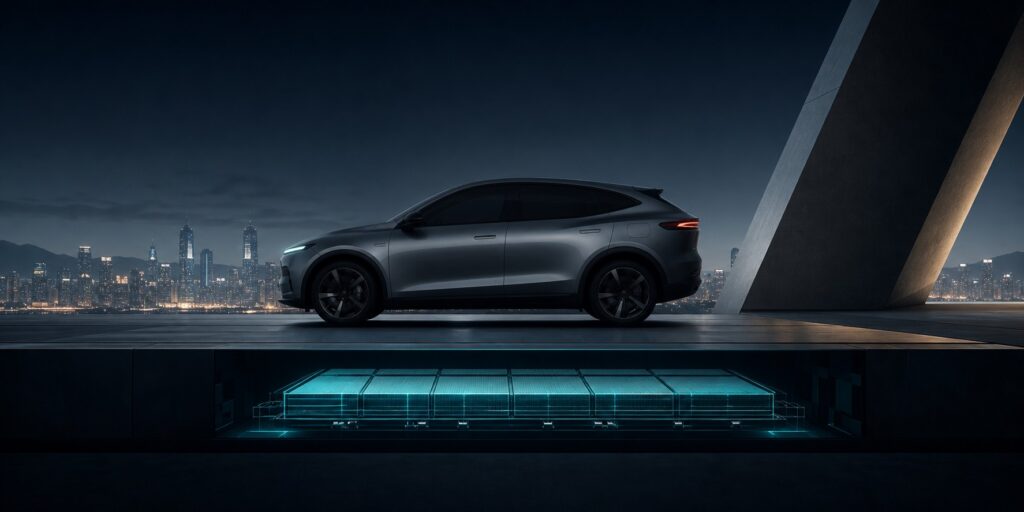
Figure 1. Electric mobility and the battery platform. Original editorial concept visual created for this article using AI image generation.
5. Drones and the Low-Altitude Economy
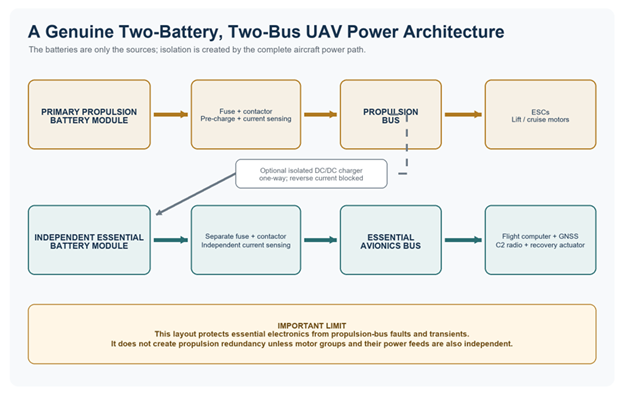
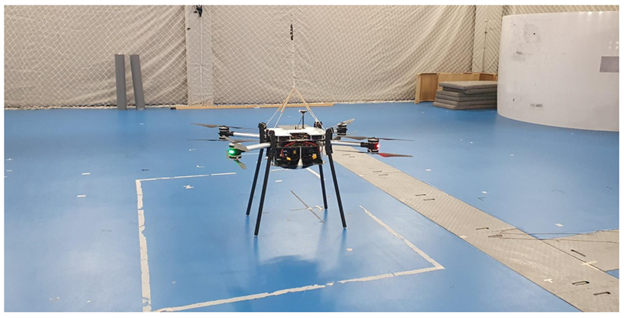
The drone industry shows why battery performance is about more than storage capacity. An agricultural drone, inspection aircraft or delivery platform must lift its own battery as well as sensors, communications equipment and payload. Every improvement in specific energy can translate into longer flight time, greater range or additional payload. At the same time, high discharge power is required during takeoff, climbing and wind correction. Fast charging or rapid battery swapping is essential when an aircraft must complete many missions per day.
China elevated the “low-altitude economy” to a national policy priority in the 2024 Government Work Report, which listed it among new growth engines.[11] The term covers far more than recreational drones. It includes agricultural spraying, mapping, power-line inspection, emergency response, logistics, urban air mobility and electric vertical takeoff and landing aircraft. The Ministry of Industry and Information Technology and other agencies have set a goal of establishing a new model for the large-scale application of general aviation equipment by 2030.[12]
Official operating data indicate how quickly the market is becoming real. The Civil Aviation Administration of China reported 45.3 million unmanned-aircraft flight hours in 2025, up 73.5% year on year. By March 2026, China had more than 3.8 million registered drones, over 430,000 licensed pilots and more than 40,000 operating enterprises. Agricultural drones alone numbered about 300,000 and served roughly 460 million mu of farmland.[13]
For this sector, battery innovation must balance six requirements: high specific energy, high power, fast turnaround, low-temperature reliability, accurate state estimation and exceptional safety. Aviation is less tolerant of uncertainty than road transport. A battery that is acceptable in a car may be too heavy, too slow to charge or too difficult to certify for an aircraft. The low-altitude economy will therefore push Chinese producers toward lighter pack structures, aviation-grade monitoring, redundant safety design and more predictable aging. It may also become an early commercial market for semi-solid or solid-state cells if those technologies can demonstrate reliable manufacturing and competitive cost.
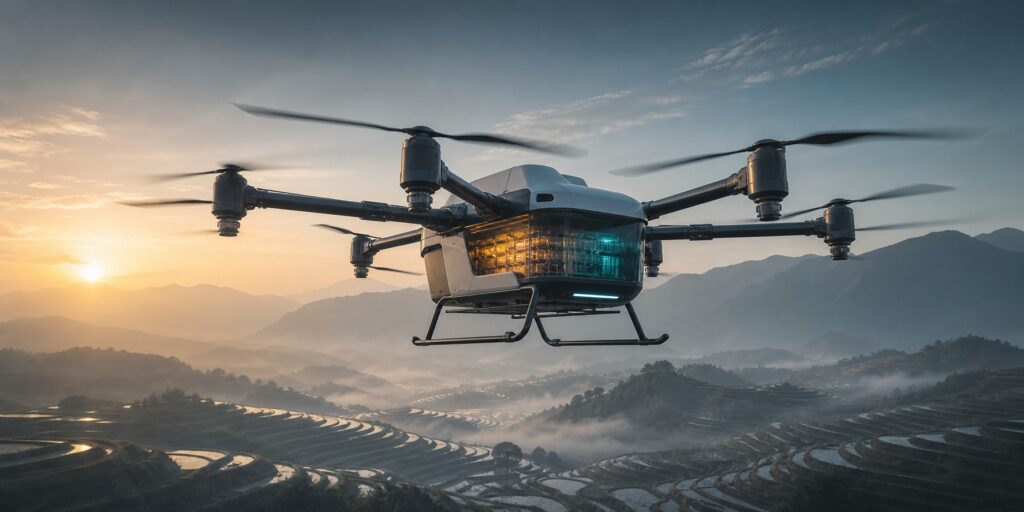
Figure 2. Battery-powered flight and the low-altitude economy. Original editorial concept visual created for this article using AI image generation.
6. Grid Storage: Turning Renewable Electricity into Reliable Power
Stationary storage is the third major growth engine. Wind and solar generation are variable, while electricity demand changes by hour and season. Battery systems can absorb excess power, respond rapidly to grid signals and discharge when demand rises. They can also support industrial parks, data centers, microgrids and charging hubs.
China’s National Energy Administration reported that new-type energy-storage capacity reached 136 GW by the end of 2025, and lithium-ion batteries represented 96.1% of the installed technology mix.[14] A national action plan targets more than 180 GW by the end of 2027 and estimates that the expansion could drive around RMB 250 billion in direct project investment.[15] This creates a second life for capabilities developed in the EV sector: high-volume cells, power electronics, thermal control, software and system integration.
Yet storage will also expose lithium-ion’s limits. Stationary projects must control fire propagation across large containerized systems and demonstrate reliable operation over many years. They compete on lifetime electricity cost, not simply purchase price. In some projects, sodium-ion batteries may reduce dependence on lithium and perform well in cold conditions; flow batteries or other technologies may be more attractive for longer discharge durations. China’s storage market is therefore likely to become a chemistry-diverse ecosystem rather than a copy of the vehicle-battery market.
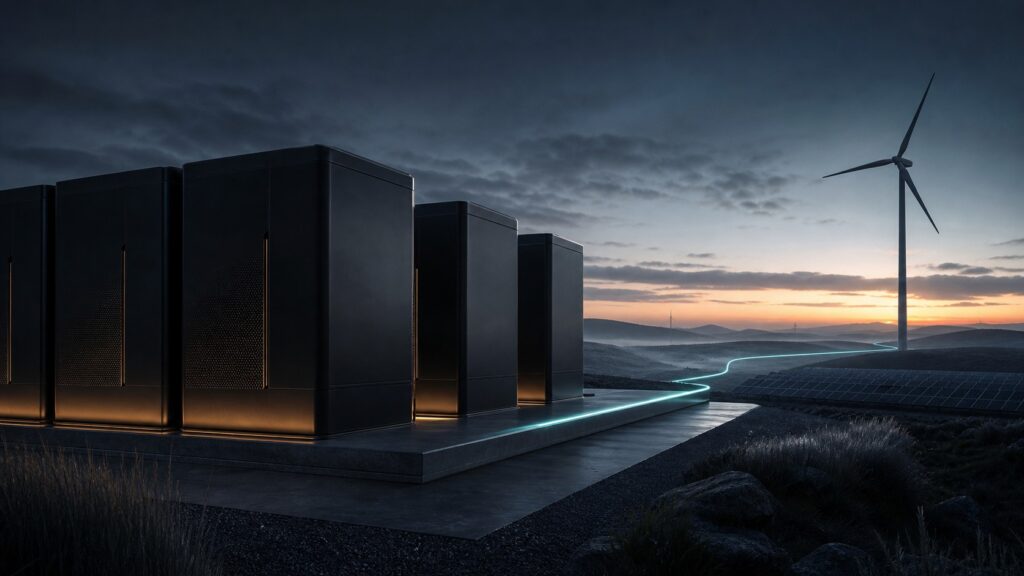
Figure 3. Battery storage connecting renewable generation to reliable power. Original editorial concept visual created for this article using AI image generation.
7. A Practical Roadmap for China’s Next Battery Cycle
First, safety must become a system property. Better separators, nonflammable or less-flammable electrolytes, cell venting, pack isolation, thermal barriers and predictive software should be designed together. The industry’s reputation will depend on preventing rare failures from becoming vehicle, warehouse or aviation-scale incidents.
Second, development should prioritize total lifetime value. Ultra-fast charging is commercially useful only if cells retain capacity, charging networks can supply the power and thermal systems remain affordable. For vehicles, drones and storage, the winning product will combine charging speed, cycle life, energy efficiency and predictable degradation rather than maximizing a single laboratory metric.
Third, solid-state development should be ambitious but disciplined. Solid or semi-solid electrolytes may improve safety and enable lithium-metal anodes with higher energy density. The difficult work lies in interfaces, pressure management, manufacturing yield, low-temperature performance and cost. China’s advantage will come from turning scientific progress into repeatable industrial processes—not from announcing premature mass-production dates.
Fourth, the battery should become digitally traceable. Product passports, manufacturing records, state-of-health data and standardized carbon accounting can improve quality control, financing, second-life decisions and international compliance. Artificial intelligence can support materials discovery and factory inspection, but it will be equally valuable in predicting failure and optimizing fleet charging.
Fifth, recycling must be designed into the product. China issued new interim rules for recycling and comprehensive utilization of used NEV power batteries in 2025, strengthening whole-chain supervision and traceability. The government reported that recycled battery volumes exceeded 400,000 tonnes in 2025, up 32.9% year on year.[16] Future packs should be easier to identify, diagnose, disassemble and process. Recycling will not eliminate the need for mining, but it can reduce waste, recover strategic materials and stabilize supply.
Finally, China should continue chemistry diversification. LFP will remain important for affordable vehicles and storage. Nickel-rich cells will serve applications where range and weight justify their cost. Sodium-ion batteries may become competitive in selected entry-level vehicles, cold climates and stationary systems. Solid-state and lithium-metal technologies may first appear in premium vehicles, aircraft or specialized equipment. A resilient industry will match chemistry to mission instead of forcing one battery into every market.
Conclusion: From Battery Scale to Battery Intelligence
China’s lithium-battery rise began with consumer electronics, accelerated through coordinated electric-vehicle policy and matured through enormous manufacturing scale. Its historical advantage is now embedded in industrial clusters, engineering experience, chemistry innovation and a domestic market large enough to test new products quickly. Those strengths explain why China leads EV battery production and why the same supply chain is spreading into drones, low-altitude aviation and grid storage.
The next phase will be harder. Cost and capacity remain important, but global leadership will increasingly depend on safety, carbon performance, recycling, software, aviation-grade reliability and credible technical standards. Lithium-ion will not be replaced by one miraculous chemistry. It will evolve into a family of specialized systems, supported by sodium-ion, flow batteries and other storage technologies where they make more economic sense.
The central opportunity is clear: China can move from being the world’s largest battery manufacturing base to becoming the world’s most sophisticated battery-application ecosystem. If the industry measures success by safe energy delivered over a product’s full life—not simply by annual gigawatt-hours—it can remain a foundation of electric mobility, clean power and the low-altitude economy for decades to come.