Before a seasonal shutdown, set each drone battery to its manufacturer’s storage charge level, place it in a dry environment within the specified temperature range, and schedule the next inspection. Before returning it to service, review its condition and history, complete the required maintenance, and verify its behavior during an approved operational check.
For agricultural contractors, survey teams and industrial UAV operators, this work belongs in the fleet schedule. A problem found before spring mobilization gives the buyer time to arrange inspection or replacement. This guide covers removable lithium-based flight batteries, including LiPo and intelligent packs. Exact charge levels, temperature limits and maintenance procedures must match the battery model and its current documentation.
Why batteries still need attention during a shutdown
Powering a battery off does not stop every source of energy loss. Self-discharge and the electronics inside an intelligent pack can gradually reduce its charge. DJI’s maintenance guidance explains that a battery left with very little energy can become over-discharged during storage, potentially causing permanent damage. [9]
A pack that finished the season almost empty therefore needs attention before it goes on the shelf. At the other extreme, leaving the entire fleet fully charged for months defeats the purpose of storage management. The appropriate target comes from the pack manufacturer; it cannot be inferred from the battery’s capacity or connector.
Prepare each pack before it enters storage
Start with a condition check before charging or discharging. Inspect the housing or pouch, cable insulation, connector and locking mechanism. Keep swollen, leaking, deformed or damaged packs out of the charging queue and normal stock. Follow the supplier’s instructions for assessment and handling. Tattu’s smart battery manual specifically excludes damaged, bulging or leaking batteries from use. [4]
Remove serviceable packs from the aircraft where the manufacturer requires it. Keep terminals protected from conductive objects and prevent pressure on the pack or its cables. Use the cleaning method specified for that battery; a dry exterior does not establish that a pack with known water ingress is serviceable.
Give every pack an asset ID and record its serial number, model, last service date, charge level and outstanding warnings. For paired-battery aircraft, retain the pair identity and the manufacturer’s pairing rules. These records let the spring team identify what was stored, what maintenance is due and which packs are awaiting a decision.

Use the storage setting for the exact battery model
For the DJI Matrice 350 RTK’s TB65 battery, the user manual specifies a battery-station Storage Mode that charges the pack to 50%. It also describes automatic discharge toward 50%. Those are documented TB65 behaviors, not a universal setting for every UAV pack. [1]
For a conventional pack used with a programmable charger, obtain the approved storage voltage and charger profile from the supplier. Confirm the chemistry, series cell count and maximum charging voltage before selecting a program. A storage percentage and a per-cell voltage are different specifications; a linear conversion between them is not a reliable way to set a charger.
Automatic discharge also has a defined trigger. Skydio’s March 2026 X10 maintenance manual says its batteries begin self-discharge after 14 idle days without flights, with discharge taking several more days. The manual notes that slight warmth during this process can be normal. Record the actual battery state and scheduled check date even when this feature is available. [3]
Choose a storage environment for the whole winter
The temperature that a battery tolerates for a short period may be wider than its long-term storage range. Skydio publishes −20 to 45°C (−4 to 113°F) for X10 flight batteries stored for less than three months, and 25 ± 3°C for storage over three months. The latter means 22 to 28°C (71.6 to 82.4°F). [2]
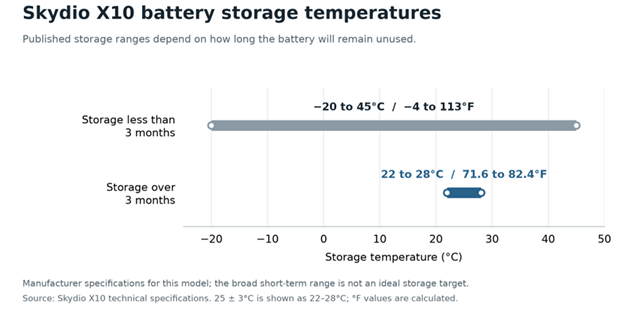
The wide short-term range is not an ideal target. Skydio’s maintenance guidance recommends 22–28°C storage more generally, with a cool, dry location and relative humidity below 75%. [8]
For a mixed fleet, check that the chosen room falls within the storage requirements of every pack assigned to it. A useful warehouse control is a temperature logger near the stored batteries, with a named person responsible for reviewing excursions. Record the conditions at the storage location rather than assuming they match the office thermostat.
Keep batteries away from heaters, moisture and heavy items that could damage them. An unheated vehicle or shed needs particular scrutiny because its winter temperature can change substantially. Follow the manufacturer’s storage arrangement and your facility’s battery handling provisions. Tattu’s smart battery guidance calls for a temperature-controlled environment around 25°C and warns against stacking batteries. [4]
Schedule inspections and maintenance during storage
Put the next due date on the calendar when each pack enters storage. The TB65 manual calls for maintenance every 50 cycles or three months, or when DJI Pilot 2 prompts it. Skydio’s March 2026 X10 maintenance manual specifies charging and discharging vehicle and controller batteries every two months. These examples show why one fleet-wide interval needs to be checked against each model. [1] [3]
A practical fleet policy is to review the storage register monthly, while carrying out charge or discharge maintenance when the relevant manual requires it. This monthly review is an organizational recommendation. It is not an instruction to cycle every battery each month.
At each review, check the recorded charge level, visible condition and any available health warnings. Compare the result with the previous entry and the expected self-discharge behavior. Unexpected loss of charge, damage or an unresolved warning should move the pack to an assessment list. After scheduled maintenance, return a pack that will remain unused to its specified storage state.
| When | What to record | Follow-up |
| At seasonal shutdown | Asset ID, model, serial number, pair ID if used, condition and storage charge. | Assign a storage location, owner and next review date. |
| At each planned review | Date, charge level, visible changes, warnings and temperature excursions. | Investigate unexplained changes and confirm the maintenance due date. |
| When maintenance is due | Procedure used, test results, firmware status and final storage charge. | Record completion or keep the pack on hold if an issue remains. |
| Before return to service | Inspection result, charging result, operational check and reviewer. | Release serviceable packs or arrange supplier assessment or replacement. |
Return stored batteries to service in stages
Inspect the pack and review its history
Allow time before the first commercial job to inspect each pack and resolve overdue maintenance. Look for damage, loose or contaminated contacts, swelling and evidence of moisture. Check age, cycle count and any retirement rule that applies to the model. Review the storage record for low-charge periods or temperature excursions that need supplier assessment.
Where telemetry is available, read cell voltages, temperature, battery health and fault messages through the approved system. Apply the manufacturer’s limits and test conditions. A battery that looks normal externally can still have a recorded fault that prevents release.
Warm and charge within the approved limits
A battery brought from a cold store into a warm room may develop condensation. Let it acclimatize in a dry, controlled environment and confirm that the pack and contacts are dry before connection. DJI’s winter guidance specifically identifies condensation on battery and aircraft surfaces after temperature changes. [5]
Use the approved charger and charging temperature range. Some intelligent systems provide a defined heating sequence: DJI states that TB65 batteries heat before charging in ambient conditions from −20 to 5°C. This feature does not establish that another cold battery can be charged in the same conditions. Never bypass a temperature warning or improvise direct heating. [7]
Complete the required maintenance and operational check
Follow the exact maintenance or capacity-calibration sequence for the model when it is due. DJI distinguishes these procedures in its enterprise guidance. Calibration supports the accuracy of the displayed battery percentage; it does not demonstrate that aging or physical damage has been reversed. Avoid adding deep discharge cycles as a general spring revival routine. [6]
After inspection and charging pass, use the operator’s approved check-flight or ground-test procedure before assigning a full commercial mission. Start with the required preflight battery temperature and normal landing reserve. Observe warnings, temperature and voltage behavior during the check, then inspect the pack again afterward. A successful power-on or a 100% display alone is insufficient evidence of readiness under load.
Resolve abnormal packs before the busy season
If a battery will not wake, distinguish a documented sleep mode from an unresolved fault. Use only the recovery steps specified for that exact pack and charger. A battery that remains unresponsive, reports a persistent fault or has a history of deep discharge needs supplier assessment. Repeated charging attempts and improvised jump-start methods are not a suitable release test.
Send the supplier the serial number, age, storage history, fault messages and clear photographs. For replacement orders, confirm the aircraft and firmware compatibility, connector, charging system and pairing requirements. Distributors should include an English maintenance sheet and storage instructions with each battery model so customers can maintain the same records after delivery.
Common winter storage questions
Can the batteries stay connected to a charger all winter
Only if the manufacturer explicitly specifies that arrangement. A storage-mode charger and an ordinary charging hub may behave differently. Check the documented operating mode and long-term connection instructions, and keep the inspection schedule active.
Should every battery be stored at 50 percent
Use the target for the exact model. Fifty percent is documented for TB65 Storage Mode. Other packs may specify a different range or a per-cell voltage, so confirm the required setting before charging.
Does losing charge in storage mean the battery has failed
Some loss can be expected, including deliberate automatic discharge on supported smart batteries. Compare it with the documented behavior and your previous readings. An unexplained change or a fault warning calls for investigation before use.
Preparing replacement stock or a battery order for the next season? Send your UAV model, current battery specification, fleet quantity and planned restart date with your inquiry. Include your storage conditions and charger details so the proposed battery and maintenance requirements can be checked against the way your fleet operates.
Sources
Manufacturer documents and image credits checked on 11 September 2026. Use the current instructions for the exact battery and system revision.
[1] DJI Matrice 350 RTK User Manual v1.2, battery storage and maintenance, pages 74–75
[2] Skydio X10 technical specifications, flight battery storage temperature ranges
[3] Skydio X10 Maintenance Manual, March 2026, battery storage, page 58
[4] Grepow Tattu smart battery 3.0 instruction manual, storage and safety guidance
[5] DJI Enterprise winter drone guidelines, cold conditions and condensation
[6] DJI Enterprise maintenance and calibration guidance
[7] DJI Matrice 350 RTK FAQ, TB65 self-discharge and battery heating
[8] Skydio guidance on maintaining the X10, storage and inspection
[9] DJI Battery Routine Maintenance Guide, self-discharge and over-discharge