Data note: this article distinguishes pack-level UAV battery claims, cell-level semi-solid disclosures and solid-state research milestones. The charts are designed to support technical interpretation rather than suggest that every value is commercially interchangeable.
For industrial drones, battery energy density is not a background specification. It decides whether a mapping drone can finish a corridor in one sortie, whether an inspection UAV can carry a better sensor, and whether a logistics platform can reserve enough power for wind, temperature and safe landing. That is why the latest conversation around semi-solid and solid-state lithium batteries is so important. The most interesting numbers now being discussed are no longer 200Wh/kg or 250Wh/kg. The market is watching a new ladder: 350Wh/kg commercial semi-solid UAV packs, 380Wh/kg semi-solid upgrades, 400Wh/kg-plus semi-solid cells, and 500Wh/kg solid-state aviation research.
This article is written for buyers, drone OEMs, battery integrators and technical decision-makers who want a realistic view. The 350-500Wh/kg range is exciting, but it should not be treated as one single product category. Some numbers refer to complete UAV battery packs, some to cell-level technology, and 500Wh/kg is currently best understood as a research milestone in solid-state aviation batteries. The commercial value is real, but the right question is not simply, “Who has the highest Wh/kg?” The better question is: what energy density can be delivered safely, repeatedly, with the discharge rate, cycle life and documentation an industrial UAV mission actually needs?
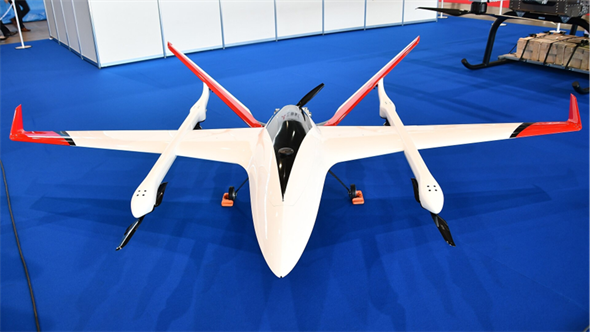
Non-standard fixed-wing VTOL UAV platforms make energy density a mission-level variable, not only a battery specification. Image: Hunini via Wikimedia Commons, CC BY-SA 4.0.
Why Wh/kg is the number every long-endurance drone buyer watches
Gravimetric energy density, measured in watt-hours per kilogram, tells buyers how much stored energy a battery can carry for its weight. In aircraft, weight is brutally important. A heavier battery increases energy capacity, but it also raises propulsion demand. A better battery is one that stores more usable energy in the same mass, or delivers the same energy with less mass. For long-endurance industrial drones, that can mean a longer route, a larger camera, a more capable thermal payload, a stronger radio link or a safer reserve margin.
The clearest commercial example is Tattu’s 350Wh/kg 33Ah 12S 44.4V semi-solid-state UAV LiPo battery. Tattu lists total energy at 1465Wh, maximum peak current at 10C, 500-plus cycle life with more than 80% capacity retention, and an advertised up to 40% longer flight time compared with the company’s stated 210Wh/kg comparison point. Those are product-page claims from one manufacturer, not a universal industry average, but they are useful because the numbers are specific enough to audit. The math is also simple: 44.4 volts multiplied by 33 amp-hours equals about 1465 watt-hours.
The next step is already visible. In January 2026, Tattu announced that its semi-solid-state battery series had advanced from 350Wh/kg to 380Wh/kg through material optimization and system-level refinement. That does not mean every UAV battery on the market has moved to 380Wh/kg. It means the high-energy UAV battery roadmap is moving from isolated product claims toward a new performance class.
Data view: the 350-500Wh/kg ladder
The chart below separates currently marketed UAV-pack data, manufacturer technology announcements, cell-level semi-solid disclosures and solid-state research milestones. This distinction matters. Pack-level energy density includes packaging, connectors and some system design. Cell-level energy density is usually higher than pack-level density. Research battery demonstrations may show what is technically possible before the technology is available as an export-ready UAV pack.
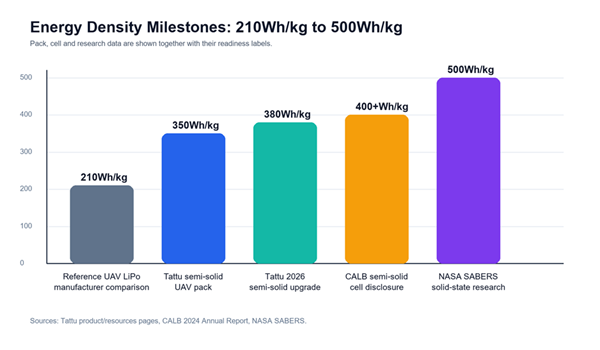
Chart 1. Energy density milestones discussed in the article. Sources: Tattu, CALB 2024 Annual Report and NASA SABERS.
| Energy density | Evidence point | How to interpret it |
| 210Wh/kg | Tattu product-page comparison point | Used as a manufacturer comparison value, not a universal market average. |
| 350Wh/kg | Tattu 33Ah 12S semi-solid UAV pack | Commercial UAV pack-level claim with 1465Wh total energy and 500+ cycle statement. |
| 380Wh/kg | Tattu 2026 semi-solid technology update | Technology-series upgrade announced for professional UAV operations. |
| 400Wh/kg+ | CALB 2024 annual report | Cell-level high energy-density semi-solid disclosure; pack density will be lower after integration. |
| 500Wh/kg | NASA SABERS solid-state aviation research | Research milestone for solid-state aviation batteries, not a standard commercial UAV pack. |
What makes a semi-solid battery different
Semi-solid battery technology sits between conventional liquid-electrolyte lithium batteries and fully solid-state batteries. The exact architecture varies by manufacturer, but the common idea is to reduce the amount of free liquid electrolyte and use more stable interfaces, gel-like or solid-containing electrolyte systems, and high-capacity electrode materials. In UAV battery marketing, semi-solid is often paired with silicon-carbon anode technology because silicon can store more lithium than graphite, although it also creates engineering challenges such as volume expansion and interface stability.
This is why serious buyers should avoid a simplistic “semi-solid equals safe and long range” message. A semi-solid battery can offer higher energy density and improved safety potential, but the delivered performance still depends on cell quality, pack structure, BMS logic, thermal pathways, connector design, charge limits and the mission profile. A battery that is excellent for a slow fixed-wing mapping UAV may not be suitable for a mission multirotor that demands high current spikes.
The U.S. Department of Energy describes next-generation batteries, including solid-state systems, as technologies that may improve performance, safety and cost characteristics while potentially changing the materials used. That framing is useful: next-generation lithium batteries are not magic boxes. They are engineered systems that must balance energy, power, safety, lifetime, cost and manufacturability.
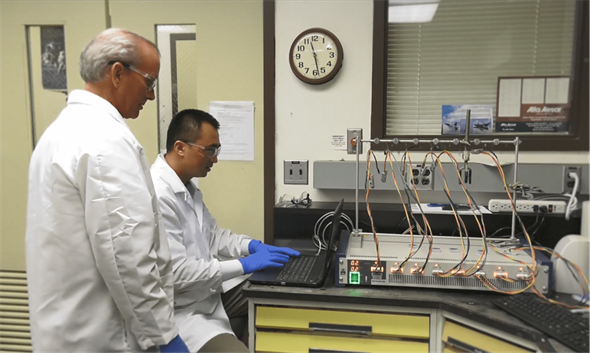
NASA’s SABERS research demonstrates why aviation customers are watching high energy-density solid-state battery development closely. Image: NASA.
From 400Wh/kg cells to aviation-grade ambitions
CALB’s 2024 annual report adds another important data point. The company disclosed a high energy-density semi-solid battery focused on intrinsic safety requirements for high-energy batteries. The report states that the cycle life is close to 1,000 times while the energy density of the battery cells exceeds 400Wh/kg, with mass deliveries scheduled for 2025. This is a cell-level disclosure, so it should not be read as proof that every complete UAV pack can already reach 400Wh/kg after casing, wiring, BMS and thermal design. But it shows why semi-solid technology is moving from laboratory language into commercial planning.
The 500Wh/kg number belongs in the same conversation, but with a clear label. NASA’s SABERS solid-state battery research has demonstrated 500 watt-hours per kilogram, and NASA says the design could eliminate 30-40% of battery weight while doubling or even tripling stored energy compared with state-of-the-art lithium-ion batteries. NASA also highlights safety properties important for aviation, including solid-state behavior when damaged and operation under higher temperatures. This is powerful evidence that aviation battery research is aiming far beyond today’s conventional lithium packs.
However, a 500Wh/kg research demonstration is not the same thing as a mass-produced 500Wh/kg UAV export battery. For buyers, that difference is healthy. It keeps expectations grounded. The practical roadmap is more likely to move step by step: validated 350Wh/kg packs, improved 380Wh/kg semi-solid series, 400Wh/kg cell-level platforms, and then higher-density solid-state architectures as manufacturing, power output, cost and certification mature.
The 5kg battery example: why energy density changes mission planning
A simple calculation shows why drone teams care. If a UAV can allocate 5kg to batteries, a 210Wh/kg pack stores about 1050Wh. At 350Wh/kg, the same battery mass stores 1750Wh. At 400Wh/kg, it stores 2000Wh. At 500Wh/kg, it stores 2500Wh. Real flight time will not rise in a perfect straight line because motor efficiency, airframe drag, payload mass, wind, temperature, discharge limits and reserve margin all matter. Still, the stored-energy difference is large enough to change system design.
There are two ways to use that gain. The first is endurance: keep the aircraft and payload the same, and fly longer. This is attractive for surveying, corridor mapping, border monitoring, offshore inspection, pipeline patrol, emergency communications and wildfire intelligence. The second is payload freedom: keep the flight time roughly the same, but carry better sensors, stronger computing, redundant communication links or safer landing reserve. In professional operations, the second option is often more valuable than headline flight time.
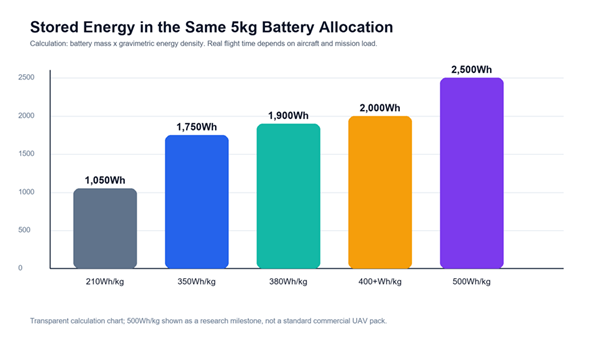
Chart 2. Stored energy calculation for the same 5kg battery allocation at different Wh/kg values.
Why higher energy density is not enough by itself
Industrial UAV batteries must provide power as well as energy. Energy is how much the bucket can hold; power is how fast it can be emptied. A fixed-wing mapping UAV may need efficient long-duration output. A mission multirotor carrying LiDAR, cargo or a gimbal may demand high discharge current during takeoff, climb, wind compensation and emergency maneuvers. If a high-energy cell cannot deliver the required current without voltage sag or excessive heat, the aircraft may lose performance even with a high Wh/kg number.
Thermal behavior is equally important. The FAA notes that lithium-ion batteries are capable of overheating and entering thermal runaway, with risk factors including damage, overheating, water exposure, overcharging and improper packing. Semi-solid and solid-state designs may improve the safety envelope, but professional packs still need conservative BMS protection, temperature sensing, charge-temperature rules, physical protection and clear handling procedures. Safety comes from chemistry plus engineering, not chemistry alone.
Cycle life must also be interpreted carefully. A claim such as 500-plus cycles or close to 1,000 cycles is only meaningful when the buyer knows the test conditions: depth of discharge, charge rate, temperature, cutoff voltage, load profile and remaining capacity threshold. Drone fleets operate differently from lab cells. They experience vibration, field charging, storage variation and uneven mission loads. A professional supplier should be able to explain how cell-level data becomes pack-level warranty and maintenance guidance.
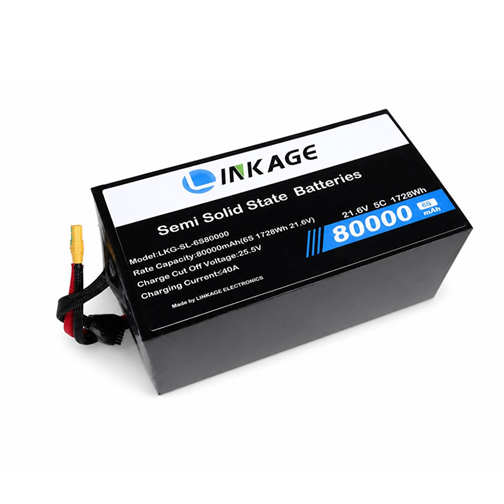
A LINKAGE 6S 80000mAh semi-solid-state Li-ion battery pack shows how cell chemistry becomes a real pack with casing, terminals, labels and field handling requirements. Image: LKGHK / LINKAGE product page.
What drone OEMs and battery buyers should request
The buyer checklist for 350-500Wh/kg technology should be technical, not emotional. Ask whether the quoted energy density is at cell level or pack level. Ask for total watt-hours, nominal voltage, rated capacity, continuous discharge current, peak current duration, working temperature range and recommended charge temperature. Ask whether the pack includes multi-point temperature sensing, BMS data logging, cycle count, state-of-health estimation and fault records. Ask for realistic flight-test data with aircraft model, payload mass, weather assumptions and landing reserve.
For import and fleet operations, documentation matters too. Lithium battery shipments need proper model identification, watt-hour rating, safety data sheets and transport test documentation such as UN38.3 test summaries where applicable. High-energy UAV packs are valuable, but they are also regulated goods. A battery that cannot be shipped, traced, inspected or documented smoothly can create operational risk even if its chemistry is impressive.
Buyers should also ask how the supplier converts cell data into pack-level engineering. A strong answer will include cell matching, compression strategy, insulation design, connector selection, cooling assumptions, firmware thresholds, production traceability and end-of-line test records. This is where many high-density claims become either credible or weak. If a supplier only offers a single Wh/kg number without discharge curves, temperature data, cycle protocol or sample BMS logs, the buyer is seeing a headline rather than a qualified power system. In long-endurance industrial UAVs, the battery is not a replaceable accessory. It is part of the aircraft architecture.
The technology direction is clear: smarter, lighter and more honest
The most attractive future is not simply a 500Wh/kg label. It is a battery system that combines higher energy density with transparent data, predictable discharge behavior, robust safety design and export-ready documentation. Semi-solid batteries are already giving UAV buyers a realistic bridge between conventional LiPo packs and future solid-state systems. They can extend endurance, reduce battery mass and make advanced payloads easier to integrate.
For Google readers and overseas buyers, the key message is this: the 350-500Wh/kg story is real, but it is a staged technology curve. The serious near-term opportunity is 350-380Wh/kg semi-solid UAV battery packs for long-endurance missions, supported by cell-level progress beyond 400Wh/kg and aviation research at 500Wh/kg. The winning suppliers will not be the ones making the loudest claims. They will be the ones who can show clean data, explain the trade-offs and deliver batteries that help industrial drones stay in the air longer, safer and with more useful payload.