Wildfire response is becoming an aviation-and-data problem as much as a ground-crew problem. In the United States, the National Interagency Fire Center reported 39,520 year-to-date wildfires and 3,633,827 acres burned as of July 15, 2026. In the European Union, the Joint Research Centre, using EFFIS data, reported 167,326 hectares burned and 1,083 fires larger than 30 hectares by the same date – more than double the long-term average number of fires for that point in the season. NOAA satellites were also monitoring significant wildfire activity across the western United States in early July 2026. For drone manufacturers, emergency operators and industrial UAV buyers, the message is clear: wildfire is no longer a seasonal edge case. It is becoming a recurring operating environment.
That shift changes how buyers should think about drone batteries. A wildfire drone is not only asked to fly. It may have to launch near hot terrain, carry thermal sensors, stream video through smoke, return with enough reserve power, cool down, recharge, and fly again. A standard battery pack that performs well in mild weather can become the weakest link when the mission moves into radiant heat, dust, high payload demand and repeated charge-discharge cycles. In this market, heat-resistant drone batteries are not a marketing luxury. They are a practical requirement for reliable wildfire UAV operations.
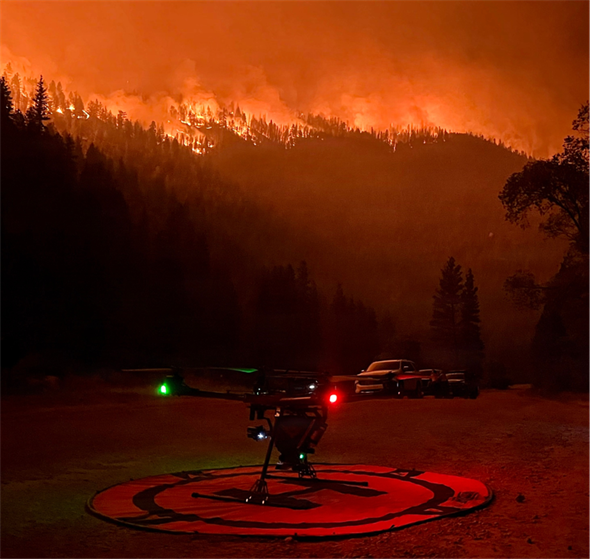
Wildfire UAS operations put drone batteries close to heat, smoke, dust and repeated launch cycles. Photo: USDA Forest Service photo by Dirk Giles via DVIDS, public domain.
Why wildfire drones are moving from experiment to essential tool
The public-safety case for drones is now well established. The FAA describes UAS in wildfire response as tools for real-time situational awareness, hotspot detection and safer operations in high-risk environments. The same FAA guidance notes their value in persistent monitoring, fire-perimeter mapping and infrastructure damage assessment. In plain language, drones help incident teams see faster, map more precisely and keep people out of unnecessary danger.
The U.S. Forest Service has also been expanding drone use quickly. According to a USDA Forest Service/DVIDS feature, Forest Service drone flights on active incidents increased by 2,483% from 2019 to 2025. Another Forest Service report describes contracted UAS crews providing real-time situational awareness and timely perimeter updates to command staff. It also notes that some fixed-wing wildfire drones can operate after dusk, when crewed aircraft may be grounded for safety, and that infrared sensors allow teams to see heat signatures through smoke and at night.
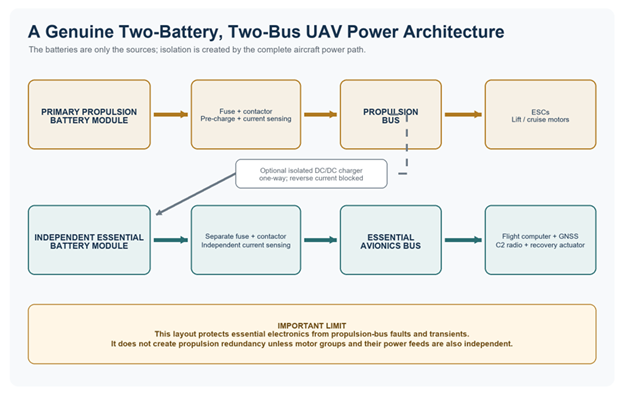
This is exactly where battery engineering becomes strategic. A thermal-imaging drone is not just a flying camera. It is a small power system carrying propulsion, avionics, sensors, data links, navigation, onboard computing and safety reserves. If the battery voltage sags under load, the sensor may remain useful but the aircraft may not. If cell temperature rises too quickly, the mission must be shortened or cancelled. If the pack has no readable BMS history, a fleet manager cannot know whether the next flight is safe enough to launch.
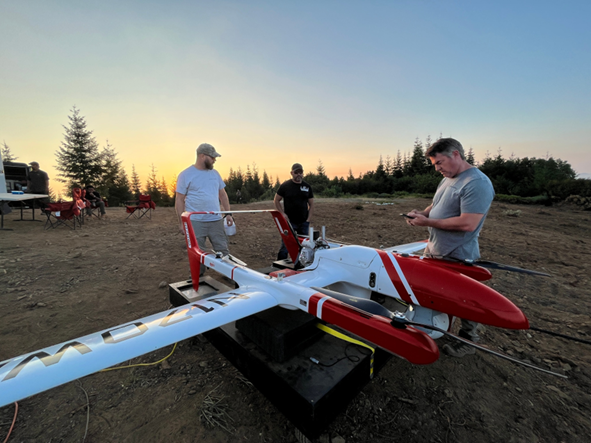
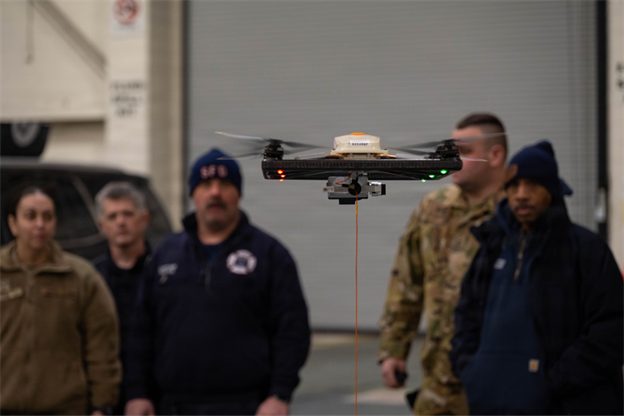
Fixed-wing wildfire UAS crews use drones for real-time situational awareness and perimeter updates. Photo: USDA Forest Service photo by Andrew Avitt via DVIDS, public domain.
The battery challenge: heat, payload and mission tempo
Wildfire operations stress lithium batteries in several ways at once. The first is thermal exposure. A drone may not fly inside flames, but it can operate near hot ground, smoke columns and equipment staging areas where ambient temperature is far from laboratory conditions. The FAA warns that lithium ion batteries are capable of overheating and entering thermal runaway, and that risk factors include damage, overheating, water exposure, overcharging and improper packing. For professional UAV buyers, the lesson is not to fear lithium batteries. The lesson is to demand pack design, BMS safeguards and handling procedures that respect the actual environment.
The second stress is payload. Wildfire UAVs often carry infrared or thermal cameras, mapping payloads, high-brightness indicators, radios or edge-computing modules. These systems draw power continuously. A battery advertised with an impressive flight time but tested without payload, wind, heat or reserve margin can create unrealistic expectations. Serious operators should ask for flight-time data under mission conditions: aircraft model, payload mass, ambient temperature, wind assumption, discharge limit and landing reserve.
The third stress is mission tempo. A wildfire is not a one-flight event. Teams may need short sorties for division-level reconnaissance, longer flights for perimeter mapping, battery swaps at temporary staging points and charging in vehicles or field bases. In this rhythm, the battery pack must be easy to identify, fast to inspect and difficult to connect incorrectly. A rugged case, clear serial-number tracking, reliable locking connectors and readable health data can matter as much as nominal capacity.
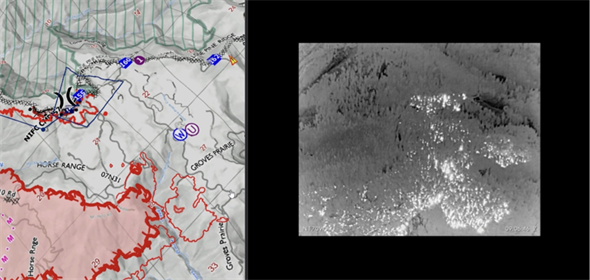
Thermal and mapping payloads increase power demand, making stable battery output and BMS data important. Photo: USDA Forest Service photo by Andrew Avitt via DVIDS, public domain.
What a heat-resistant wildfire drone battery should prove
A better wildfire UAV battery is not simply a bigger battery. More capacity adds mass, and mass increases propulsion demand. The stronger solution is a pack designed around the mission profile. Cell selection should match continuous current, peak current, operating temperature range and cycle-life expectations. The BMS should monitor voltage, current and temperature with conservative protection logic. For larger professional packs, multi-point temperature sensing is especially useful because one hot cell group can become a warning sign before the whole pack shows a problem.
Good suppliers should be comfortable discussing derating. In high heat, safe available power may be lower than the number printed on a data sheet. That is not a weakness if it is documented. It is a sign that the battery was engineered for honest field use. A supplier that can provide temperature-limit behavior, charge-temperature rules, cycle-life test conditions and BMS log access gives the buyer a way to manage risk instead of guessing.
Documentation also matters because wildfire drone fleets move across borders and agencies. For lithium batteries, PHMSA guidance states that batteries must be subjected to design tests under UN Manual of Tests and Criteria subsection 38.3 and that manufacturers and distributors must make lithium battery test summaries available using standardized elements. For importers, integrators and emergency contractors, a complete documentation package – UN38.3 test summary, MSDS/SDS, watt-hour rating, model identification and transport classification – can save time when a shipment is urgent.
Buyer checklist for wildfire UAV battery packs
Before choosing a supplier, ask practical questions that connect directly to field performance. What is the validated operating temperature range? What is the continuous discharge rating, not only peak discharge? How was flight time tested, and with what payload? Does the BMS record temperature, current, voltage and cycle count? Can the pack limit charge or discharge when temperature is outside a safe range? Are connectors vibration-resistant and protected from dust and accidental short circuit? Can the supplier provide serial-number traceability for fleet maintenance?
These questions are simple, but they separate professional UAV power systems from commodity battery packs. A wildfire operator does not need exaggerated claims. The operator needs a battery that behaves predictably, communicates its condition and gives the pilot enough reserve to make conservative decisions. Reliability, in this context, is not only longer flight time. It is fewer surprises.
| Requirement | Why it matters | Buyer question |
| Operating temperature | Shows whether the pack is suitable for hot staging areas and repeated flights. | Ask for validated test conditions and derating behavior. |
| Continuous discharge rating | Wildfire payloads draw steady power, not only short peaks. | Compare continuous current with real aircraft load. |
| BMS data logging | Temperature, voltage, current and cycle history support safer fleet decisions. | Request sample log output and alarm thresholds. |
| Payload-based flight tests | Thermal cameras, mapping sensors and radios reduce practical endurance. | Ask for tests with payload, wind assumption and landing reserve. |
| Connector and casing design | Dust, vibration and field handling can create avoidable failures. | Check locking connectors, insulation and short-circuit protection. |
| Transport documentation | Urgent overseas shipments need compliance-ready paperwork. | Request UN38.3 test summary, SDS/MSDS and watt-hour/model data. |
Where the market is going next
The next stage of wildfire drone power will be smarter, not just larger. Autonomous drone docks near forests, long-endurance fixed-wing UAVs, thermal mapping swarms and AI-supported fire-perimeter updates all depend on repeatable battery performance. The pack will need to work as a data source, feeding state-of-health, temperature history and cycle information into fleet-management systems. This will help operators decide which packs are ready for high-risk missions, which should be reserved for training and which should be retired.
New chemistries may improve energy density and safety over time, but near-term progress will come from disciplined engineering: better thermal design, safer charging logic, robust casing, higher-quality cells, smarter BMS firmware and transparent test reporting. For wildfire UAVs, the winning battery will not be the one with the loudest claim. It will be the one that keeps delivering stable power when the air is hot, the payload is heavy and the mission cannot wait.
For drone OEMs, importers and emergency-technology buyers, this is the opportunity. Wildfire drones are becoming part of the modern response toolkit. The battery pack that powers them should be specified with the same seriousness as the airframe and sensor. In the age of extreme fire seasons, heat-resistant UAV batteries are not merely components. They are mission infrastructure.