Drone delivery has spent years being treated like a future-facing demo: impressive, photogenic, and always one regulatory step away from everyday use. That story is changing. Around the world, drone delivery is moving from carefully managed pilots into larger logistics networks for groceries, medicine, food, and urgent small parcels. The most important part of that shift is not only the aircraft or the app. It is the battery system that lets each aircraft fly safely, repeatably, and economically throughout the day.
For buyers, OEMs, and logistics operators, this creates a simple reality: a delivery drone is only as scalable as its power system. A fleet that can fly one impressive route is interesting. A fleet that can fly hundreds of predictable routes, recharge quickly, document battery safety, handle heat and light weather, and return consistent data to operators is commercially useful. That is why lithium battery selection is becoming a board-level decision for serious drone delivery programs.
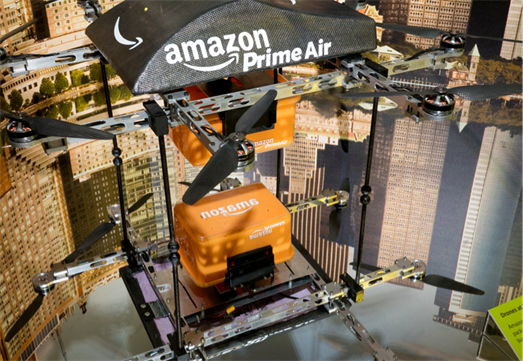
Commercial drone delivery concepts have matured into real logistics programs. Photo: William Warby, CC BY 2.0, via Wikimedia Commons.
Why 2026 Feels Different for Drone Delivery
The market is no longer built only on prototypes. Wing, an Alphabet company, says it has completed more than one million commercial home deliveries. In January 2026, Wing and Walmart announced a coast-to-coast expansion to an additional 150 Walmart stores over the next year, aiming to bring drone delivery access to more than 40 million Americans and create a network of more than 270 drone delivery locations. That is not a small laboratory test; it is retail infrastructure being connected to the sky.
Amazon has followed a similar path of integration. Its Prime Air program describes the MK30 as a smaller, quieter aircraft designed for greater range, light-rain operation, and delivery of eligible packages up to five pounds in about an hour. Amazon has also emphasized that drone delivery is being integrated into existing fulfillment infrastructure, including Same-Day Delivery sites. In other words, drone delivery is becoming part of the logistics stack, not a separate science project.
Zipline shows the same trend from another angle: medical and essential delivery. On its official site, Zipline reports more than 1.96 million deliveries made and over 125 million miles flown at the time of access. Its system has roots in medical delivery in Rwanda and now includes food, grocery, and healthcare logistics. The lesson is clear: where ground delivery is slow, expensive, traffic-bound, or geographically difficult, small autonomous aircraft can create a new service layer.
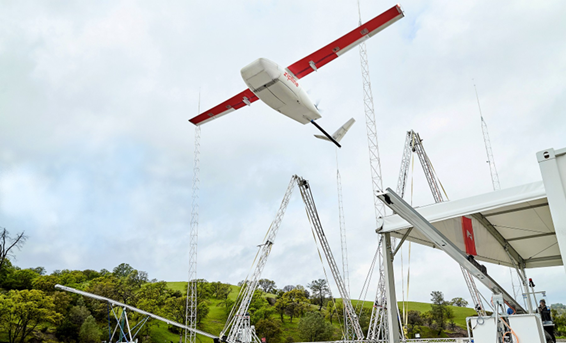
A launch system makes drone delivery repeatable, not just airborne. Photo: Roksenhorn, CC BY-SA 4.0, via Wikimedia Commons.
The Battery Is Where Scale Becomes Real
Lithium-ion batteries are the natural foundation for this market because they combine light weight, high energy density, and rechargeability. The U.S. Department of Energy identifies those same advantages as core reasons lithium-ion technology has become common in products ranging from electronics to electric vehicles. For drones, the value is even more direct: every gram saved in the battery pack can become more range, more payload, more reserve power, or more robust safety margin.
But delivery drones ask more from batteries than a hobby aircraft does. They fly scheduled routes, repeat cycles, carry payloads, and may operate under changing temperatures, wind, and humidity. They also need batteries that can be swapped, charged, tracked, and shipped across borders without creating operational risk. A battery that looks acceptable in a datasheet can fail a fleet if its voltage sag is high, its cells age inconsistently, its BMS data is limited, or its documentation is incomplete.
Regulators are already paying attention. In a 2026 FAA environmental review page for proposed drone package delivery operations, the FAA describes Wing aircraft as electric and powered by rechargeable lithium-ion batteries. The same public documentation discusses small-package payloads and unmanned aircraft operating from a network of nests. That kind of wording matters: the battery is not a hidden accessory. It is an operational component inside a regulated aviation service.
What Global Buyers Should Evaluate
For a drone delivery program, the battery question is not simply, “How many minutes can it fly?” The better question is, “How reliably can this pack support the real mission profile over hundreds of commercial cycles?” A smart sourcing process should connect the battery specification to the aircraft, payload, route length, charging rhythm, climate, and transport plan.
| Battery factor | Why it matters | Buyer question |
| Energy density | Supports useful range and payload without making the aircraft too heavy. | What is the tested Wh/kg at pack level, not just cell level? |
| Voltage stability | Prevents sudden performance loss during takeoff, wind, climb, or payload delivery. | How much voltage sag occurs under the aircraft’s real discharge profile? |
| BMS and data | Enables fleet tracking, balancing, protection, maintenance planning, and safer charging. | Can the BMS share cycle count, cell voltage, temperature, alarms, and SOC/SOH? |
| Thermal behavior | Commercial routes may face hot roofs, cold mornings, light rain, or long standby time. | What temperatures were used in cycle-life and discharge testing? |
| Transport documents | Lithium batteries must move safely through air, sea, and courier networks. | Can the supplier provide UN38.3, MSDS, labeling, and packing guidance? |
Why Delivery Fleets Expose Weak Batteries Fast
Drone delivery is unforgiving because small problems repeat many times. A pack that charges slowly reduces daily aircraft utilization. A pack that overheats forces operators to wait between flights. A pack with inconsistent cells increases maintenance cost and can shorten replacement intervals. A pack without clear transport paperwork slows export, customs clearance, and after-sales replacement. In a single demonstration, these issues may stay invisible. In a commercial network, they become expensive.
This is where professional UAV lithium batteries differ from generic packs. A good delivery-drone battery is designed around the duty cycle. It should balance power output and energy capacity, protect against overcharge and over-discharge, manage temperature, communicate with the aircraft, and maintain consistent performance after repeated charge-discharge cycles. For higher-value fleets, traceability also matters: batch records, cell sourcing, BMS firmware, production inspection, and test reports help operators manage risk.
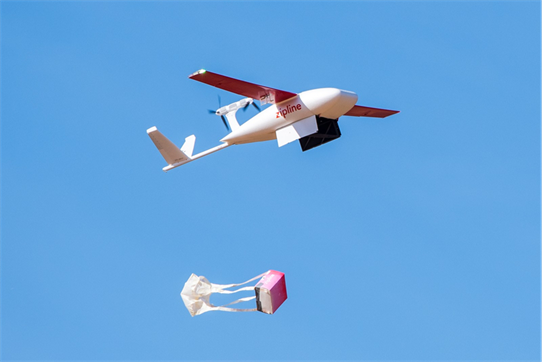
Medical and essential-goods delivery helped prove the value of airborne logistics. Photo: Roksenhorn, CC BY-SA 4.0, via Wikimedia Commons.
The Most Attractive Use Cases Are Small, Urgent, and Repeatable
The strongest drone delivery opportunities are not necessarily heavy cargo. They are small items with high urgency or high service value: pharmacy orders, medical samples, replacement parts, fresh food, convenience goods, campus logistics, island communities, mining sites, offshore facilities, and rural routes where roads create long detours. These are exactly the missions where a five-pound payload limit can still be commercially meaningful.
For battery exporters, this is important. The future of drone delivery will not be one universal battery. It will be a family of application-specific packs: lightweight packs for short urban routes, high-cycle packs for dense retail networks, longer-range packs for fixed-wing medical delivery, and ruggedized packs for hot, cold, dusty, or coastal environments. The supplier that understands the mission will look more valuable than the supplier that only quotes voltage and capacity.
A Practical Sourcing Framework
Before choosing a drone lithium battery supplier, global buyers should define the mission in operational terms. How heavy is the payload? How far is the round trip? What reserve margin is required? How many flights per aircraft per day? What is the charging window? Will packs be swapped by staff or charged on docking equipment? What is the expected ambient temperature range? What certifications and documents are needed for import, storage, and shipment?
A serious supplier should be able to answer with more than a nominal voltage and capacity. The conversation should include cell chemistry, pack structure, discharge curves, cycle-life assumptions, BMS functions, connector durability, enclosure design, charger compatibility, transport classification, and test conditions. If a buyer is building a delivery network, the battery is not a consumable afterthought. It is part of the aircraft’s reliability system.
What This Means for Battery Exporters
The global opportunity is not limited to one country or one platform. Drone delivery is being tested and expanded in dense suburbs, medical corridors, industrial sites, islands, rural communities, and campus-style operations. These markets do not all need the same pack. A short-range retail network may value fast charging, low noise support, and predictable cycle life. A medical route may value range, stable discharge, cold-chain reliability, and clear maintenance data. A coastal or tropical route may need stronger sealing, corrosion resistance, and better temperature control.
That is why the most persuasive battery suppliers will speak the language of operations, not only the language of components. Instead of promising impossible flight times, they should help buyers calculate safe reserve margins. Instead of claiming universal compatibility, they should discuss connectors, BMS communication, charger matching, enclosure dimensions, and test reports. Instead of selling only a sample pack, they should be ready to support repeat orders, documentation, and quality consistency. In drone delivery, credibility sells better than exaggeration.
Conclusion: The Sky Will Belong to Reliable Power
Drone delivery will continue to face real limits: regulation, weather, noise, landing zones, airspace integration, public acceptance, and cost. Yet the direction is clear. Wing, Amazon, Zipline, and other operators are showing that small autonomous delivery aircraft can move from limited trials toward repeatable service. As that happens, lithium batteries become a competitive advantage.
For OEMs, importers, and fleet operators, the best battery partner is not simply the cheapest quote. It is the partner that can support performance, safety, documentation, and customization at commercial scale. Drone delivery is entering a more practical era. The winners will be the teams that treat battery systems as infrastructure – tested, traceable, transport-ready, and built for the everyday rhythm of real logistics.