Introduction
We are standing on the edge of a new era in energy storage. As industries demand safer, higher-capacity, and more efficient power solutions, the question “How long do solid-state batteries last?” has become pivotal.
Solid-state technology is no longer just a futuristic concept; it is actively reshaping how we power everything from advanced UAVs and drones to electric vehicles and portable electronics. In this comprehensive guide, we will move past the hype and dive into the mechanics of solid-state batteries, exploring their true lifespan, the science behind their durability, and how you can maximize the lifecycle of your high-energy-density investments.
The Mechanics: What Makes Solid-State Different?
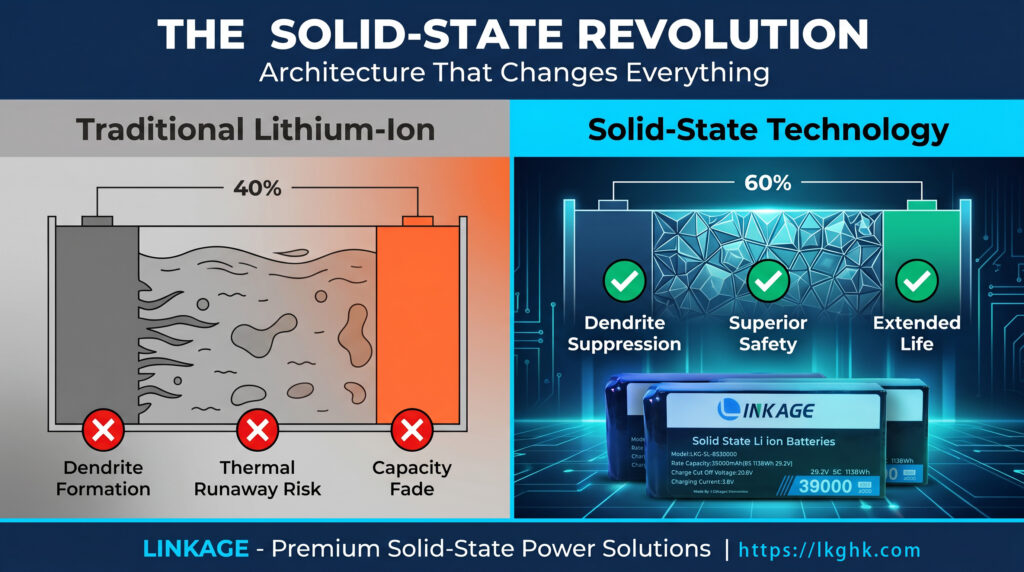
To understand their lifespan, we first need to understand their architecture. Traditional lithium-ion batteries rely on liquid electrolytes to move ions between the anode and cathode. While effective, these volatile liquids are prone to degradation, leakage, and thermal runaway (fire risks).
Solid-state batteries fundamentally change this equation. By replacing the liquid electrolyte with a robust solid material—such as ceramics, glass, or solid polymers—these batteries achieve a much higher energy density. More importantly, this solid architecture drastically improves safety and creates a highly stable internal environment, which is the primary reason for their extended lifespan.
Decoding the Lifespan of Solid-State Batteries
So, how long do they actually last? The short answer: significantly longer than their traditional lithium-ion counterparts.
The primary enemy of battery longevity is “dendrite growth”—microscopic, needle-like structures that form inside liquid batteries over time, eventually short-circuiting the cell. The solid electrolyte in a solid-state battery acts as a physical barrier, effectively suppressing dendrite formation.
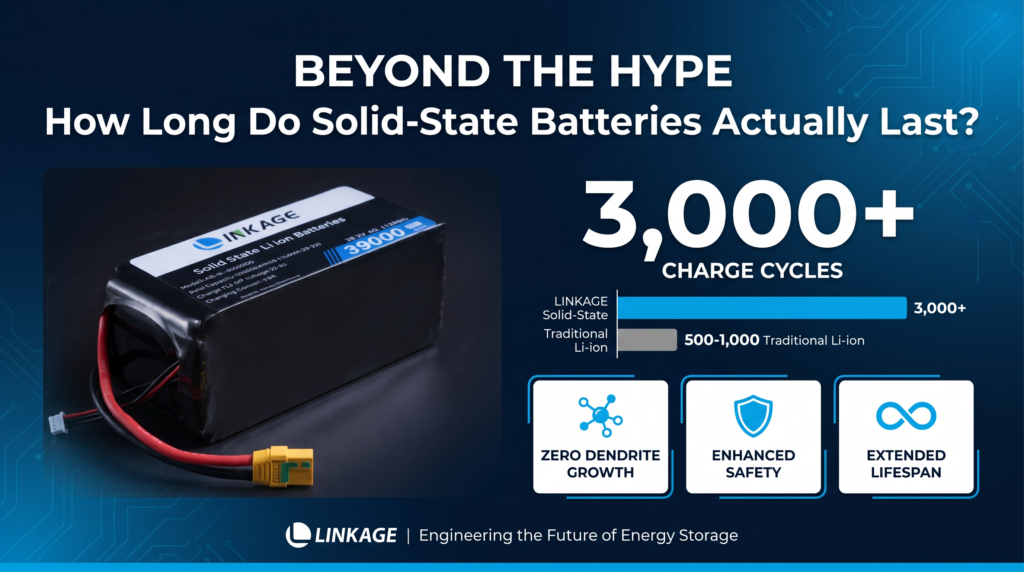
This structural integrity means solid-state batteries can handle thousands of charge cycles with minimal capacity degradation. While a standard lithium-ion battery might begin to lose significant capacity after 500 to 1,000 cycles, high-quality solid-state batteries are engineered to maintain peak performance well beyond those limits. They represent a resilient, long-term power solution designed for demanding applications.
Expert Best Practices: Maximizing Solid-State Battery Longevity
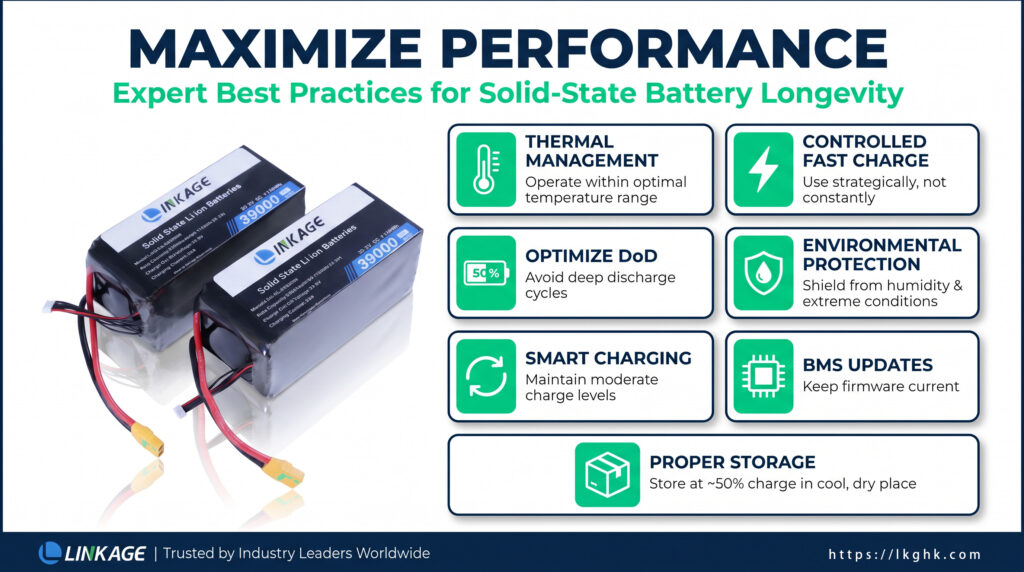
While solid-state cells are inherently more durable, applying proper battery management strategies will push their lifespan to the absolute maximum. Here are the engineering best practices we recommend:
-
- Precision Thermal Management: Although solid-state batteries are highly resistant to thermal runaway, extreme heat or freezing temperatures can still impact long-term chemical stability. Always operate and store your batteries within the manufacturer’s recommended temperature ranges.
-
- Optimize Depth of Discharge (DoD): Avoid routinely draining the battery to 0%. Maintaining a moderate charge and avoiding deep discharges will significantly reduce wear on the internal cells.
-
- Strategic Charging Cycles: Consistent, moderate charging is preferable to leaving the battery depleted for extended periods.
-
- Controlled Fast Charging: Solid-state technology is excellent at handling rapid charging. However, generating excess heat through constant, back-to-back fast charging can cause micro-degradation. Use fast charging when necessary, but rely on standard charging for routine top-ups.
-
- Environmental Protection: Keep battery packs shielded from high humidity, direct prolonged sunlight, and water ingress to maintain the integrity of external casings and connection points.
-
- Firmware and BMS Updates: Always ensure your device’s Battery Management System (BMS) software is up to date to optimize charge flow and cell balancing.
- Proper Long-Term Storage: If you need to store a battery for months at a time, keep it in a cool, dry environment at roughly a 50% charge state. Never store a battery fully depleted or at 100% capacity.
The Premier Source for Solid-State Power: Linkage
When engineering high-performance hardware, the quality of your power source dictates the success of your project. Whether you are integrating power systems for industrial applications or seeking cutting-edge energy storage, you need a manufacturing partner you can trust.
At Linkage, we specialize in the development and global distribution of premium solid-state and high-energy-density batteries. We design power solutions that deliver uncompromising safety, extended cycle life, and maximum efficiency.
Our digital platform is built for professionals. We provide transparent technical specifications, detailed datasheets, and direct access to the latest advancements in battery technology. Visit our catalog to explore how Linkage can power your next generation of products.
Frequently Asked Questions (FAQs)
Do solid-state batteries experience capacity degradation over time? Yes, all chemical batteries eventually degrade. However, due to the stability of the solid electrolyte, solid-state batteries experience a significantly slower rate of degradation per charge cycle compared to traditional liquid-based batteries.
Does frequent charging harm a solid-state battery? No. In fact, regular, moderate charging (keeping the battery between 20% and 80%) is highly beneficial and puts less stress on the cells than allowing it to drain completely before recharging.
Are there specific charging voltages I should use? Always adhere strictly to the voltage and amperage recommendations provided by the manufacturer. Using incompatible chargers can bypass the BMS and damage the solid electrolyte.
Is fast charging safe for solid-state technology? Solid-state batteries are uniquely well-suited for fast charging due to their thermal stability. However, judicious use is still recommended to minimize unnecessary heat generation over the years.
Conclusion
Solid-state batteries are not just an incremental upgrade; they are a leap forward in energy storage technology. By eliminating volatile liquids in favor of stable, solid materials, they offer a lifecycle that far outpaces traditional options. As researchers and manufacturers continue to refine this technology, solid-state power will become the gold standard across all high-demand industries. Treat them with proper care, respect their thermal and charging parameters, and they will serve as a reliable, long-term power foundation for your most critical applications.
Tags: Solid-State Batteries High Energy Density Semi-Solid State Battery Solid-State Lithium-Ion Linkage Battery Factory Energy Storage Solutions